


In a realm draped in the twilight of uncertainty, arose a king who dreamt of sculpting a kingdom where shadows surrendered to the radiant hues of justice and prosperity. He envisioned himself not as a ruler perched upon a throne, but as a force coursing through the veins of his people.
First, he became the rain that quenched the thirst of their spirits. He listened to their murmurs, their parched pleas, and understood their unspoken desires. His decrees flowed like crystal streams, nourishing the dry fields of injustice and discrimination. No matter how intricate the maze of societal prejudice, he navigated it with the clarity of a sunbeam splitting through a storm cloud.
Yet, he knew that some seeds of evil could only wither under the cold touch of the inevitable. In such cases, he donned the mantle of Death, not with the scythe of a reaper, but with the scales of unwavering justice. His judgments, though final, were tempered with the understanding that life is a tapestry woven with both darkness and light. Mercy danced alongside retribution, ensuring that punishment was a sculptor, not a destroyer.
But a king cannot merely rule through judgement and severity. He understood the need for the sun’s gentle enlightenment. He built schools where minds bloomed like gardens under the rays of knowledge. He encouraged artisans to weave stories of their aspirations into tapestries, poets to pen odes to hope, and philosophers to forge paths towards a brighter dawn. Under his reign, ignorance cowered before the incandescent blaze of curiosity.
When doubt and fear cast long shadows, he became the moon, shedding a luminescent calm over troubled waters. He walked among his people, not as a distant sovereign, but as a comforting presence. His words, woven with empathy and wisdom, soothed anxieties and rekindled embers of courage in their hearts. In the darkest hours, they looked up to him, not with trepidation, but with the quiet trust that the moon would guide them through the labyrinthine night.
He knew, however, that a king must be more than a beacon or a judge. He must be the wind that whispers the will of the people, bending with their aspirations, swaying with their grievances. He established councils where every voice found its echo, where dissent was not a weed to be uprooted but a flower to be nurtured. In doing so, he became not a ruler over them, but a conduit for their hopes and dreams.
Gold, he knew, was not merely a symbol of wealth, but of purity and unwavering resolve. He purged his court of corruption, demanding not just obedience, but integrity. He led by example, his actions a testament to the fact that a king’s true worth lay not in jewels and coffers, but in the untarnished sheen of his character.
Finally, he embraced the vastness and depth of the ocean. He delved into the forgotten corners of his kingdom, listening to the murmurs of the marginalized, the whispers of discontent in far-flung shores. He sailed across the seas of neglect, ensuring that the tide of prosperity reached even the most isolated reefs. No corner of his kingdom was too distant, no voice too faint to be heard.
And when darkness dared to rear its ugly head, he became the cleansing flame. He confronted injustice with unwavering zeal, his resolve burning bright against the encroaching shadows. He protected his people not with the brute force of a tyrant, but with the righteous anger of a shepherd guarding his flock.
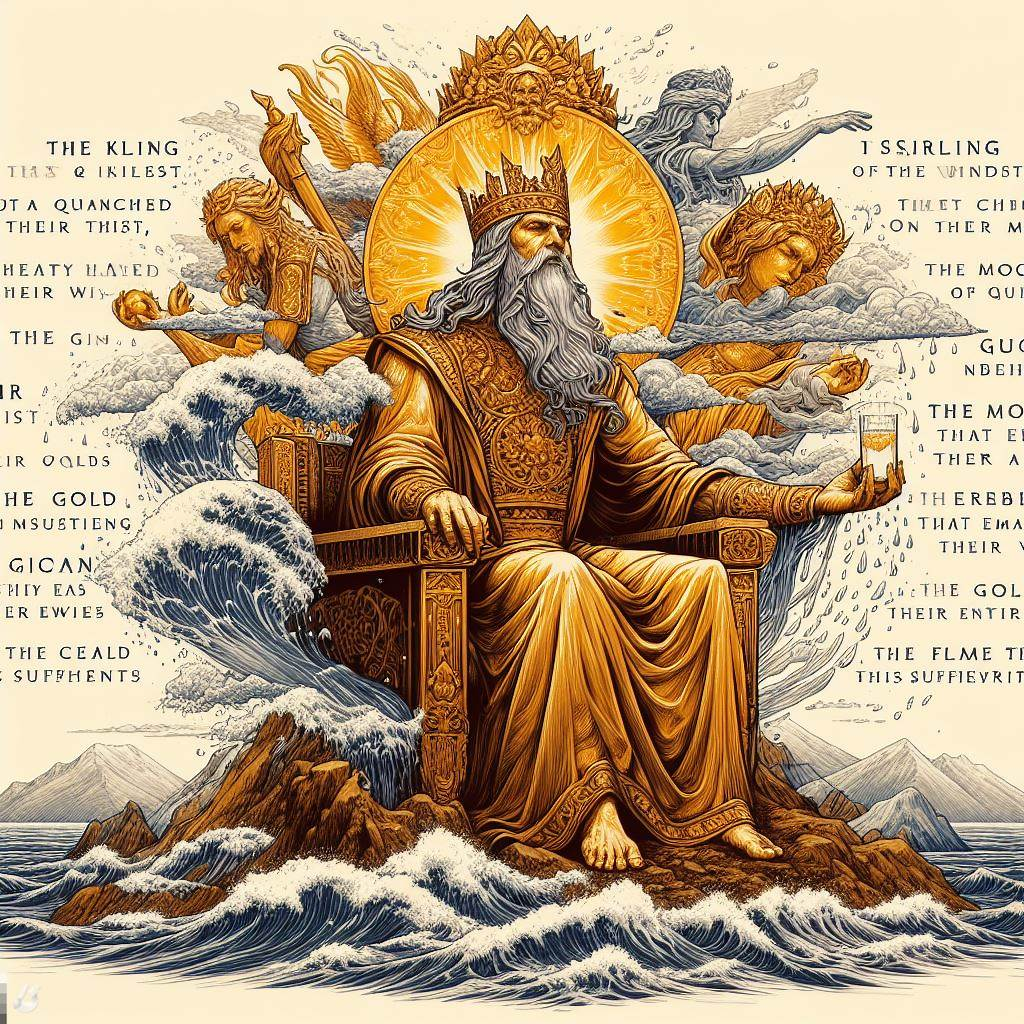
Thus, the king ruled, not as a solitary figure on a pedestal, but as a force woven into the very fabric of his kingdom. He was the rain that quenched their thirst, the sun that ignited their minds, the moon that eased their anxieties, the wind that carried their voices, the gold that embodied their aspirations, the ocean that embraced their entirety, and the flame that consumed their suffering. He was not a king who ruled over them, but a king who ruled with them, for them, and in them. And in doing so, he sculpted a kingdom where shadows dared not linger, and the radiant dawn of justice painted the sky in hues of hope.
 Bhyllabus l'énigme
Tinggalkan komentar