


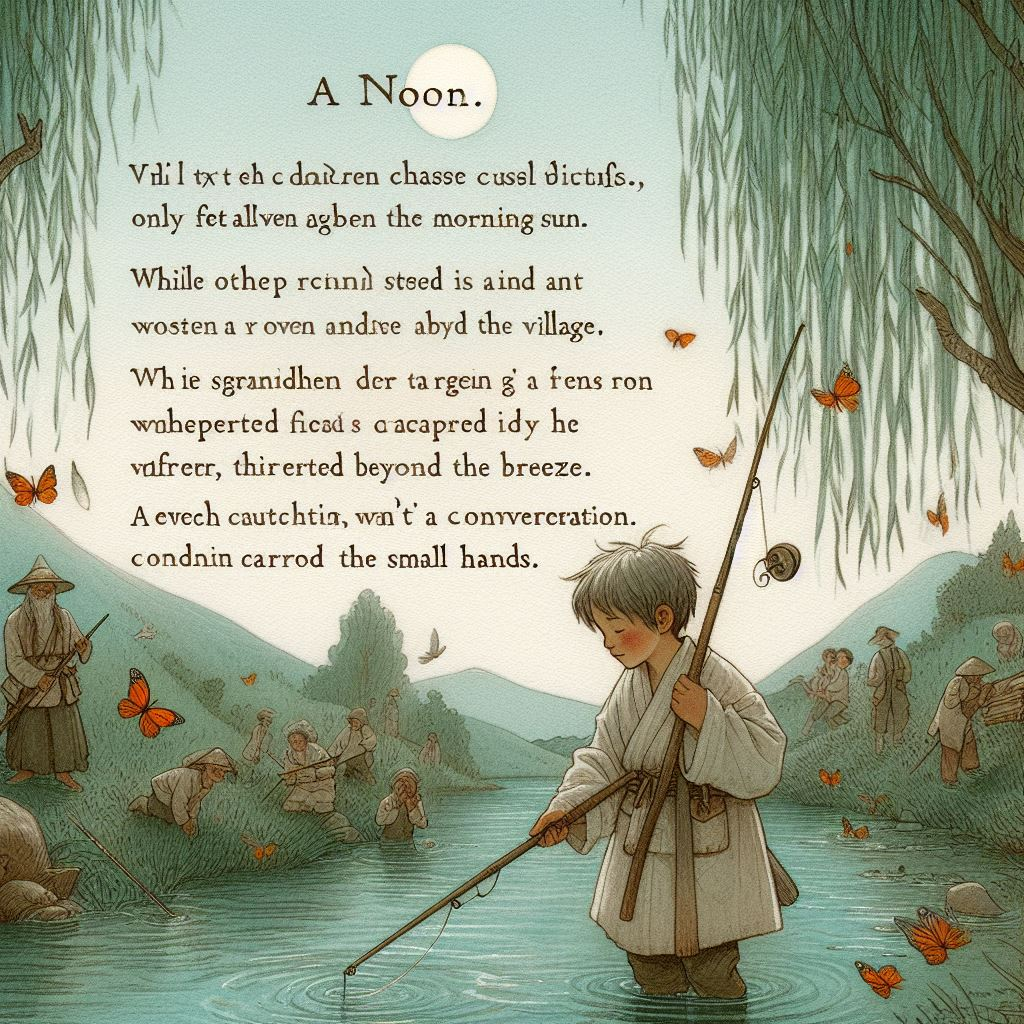
Ten-year-old Kai felt alive only at noon. While other children chased butterflies in the morning sun, he’d grab his grandfather’s weathered rod and sneak away to the hidden stream beyond the village. Noon held magic – the water danced under a benevolent sun, the willow leaves whispered secrets carried by the breeze, and anticipation for the tug of a fish vibrated in his small hands. Each catch wasn’t just a trophy, it was a conversation with the water, a silent communion with nature. He’d return sun-kissed and silent, the smell of damp earth and fish scales clinging to him like a badge of honor.
Fast forward twenty years. Kai, now clad in a crisp suit, sat in his high-rise office, city lights painting the smog-filled sky. Success, they called it. Yet, his heart felt like a neglected stream, parched and still. The clink of glasses at networking events echoed hollowly compared to the gurgling stream. The pungent aroma of his expensive cologne couldn’t replace the earthy fragrance of his childhood. Each day, the silence in his soul grew louder, a discordant note against the symphony of the city.
One evening, during a particularly soul-crushing presentation, Kai saw a picture – a boy, not unlike him, fishing by a sparkling stream. A forgotten memory surfaced, the taste of muddy water on his lips, the thrill of the fight, the quiet joy of release. Tears pricked his eyes. He wasn’t just looking at a picture; he was staring at a stranger, a ghost of who he once was.
That night, he couldn’t sleep. The city’s symphony now sounded like a cacophony. He craved the simple melody of the water, the rhythmic tug of the line. He realized success had stolen his essence, turning him into a hollow shell, a stranger to what truly made him happy.
The next morning, he did something unimaginable. He quit. The world gasped, colleagues gossiped, but Kai didn’t care. He traded his suit for worn denim, the sterile office for the earthy scent of a bait shop. He returned to the stream, not as a boy, but as a man rediscovering his soul.
The first cast was awkward, the silence unfamiliar. But as the sun warmed his face and the water whispered its welcome, a sense of peace settled in. The first tug on the line wasn’t just a fish, it was a connection, a reminder of who he was, who he always had been.
Kai never became the CEO they expected. He built a simple life, his office now the bank of a babbling stream, his colleagues the chirping birds and rustling leaves. Success, he learned, wasn’t a title or a paycheck, but the harmony between his soul and the world around him. He may have been a stranger to the city, but he was finally home, reunited with the boy who loved to fish, and in that, he found true happiness.
This is not just Kai’s story, but a parable for us all. In the pursuit of success, we often trade away our inner selves, becoming strangers to our passions. But happiness, like a fish, cannot be caught in a net of ambition. It lies in remembering who we are, embracing what truly makes our souls sing, and sometimes, in finding the courage to cast a line not for power, but for peace.

 Bhyllabus l'énigme
Tinggalkan komentar