
In the shadow of crumbling monuments, Sora stood at the edge of what would become the City of Tomorrow. They carried blueprints that seemed to shift like living things, each line drawn not just in ink but in the weight of everything that came before.
The paradox lived in their bones: to build tomorrow, one must stand on the foundations of yesterday. Yet those same foundations threatened to dictate every angle, every curve, every soaring bridge they imagined.
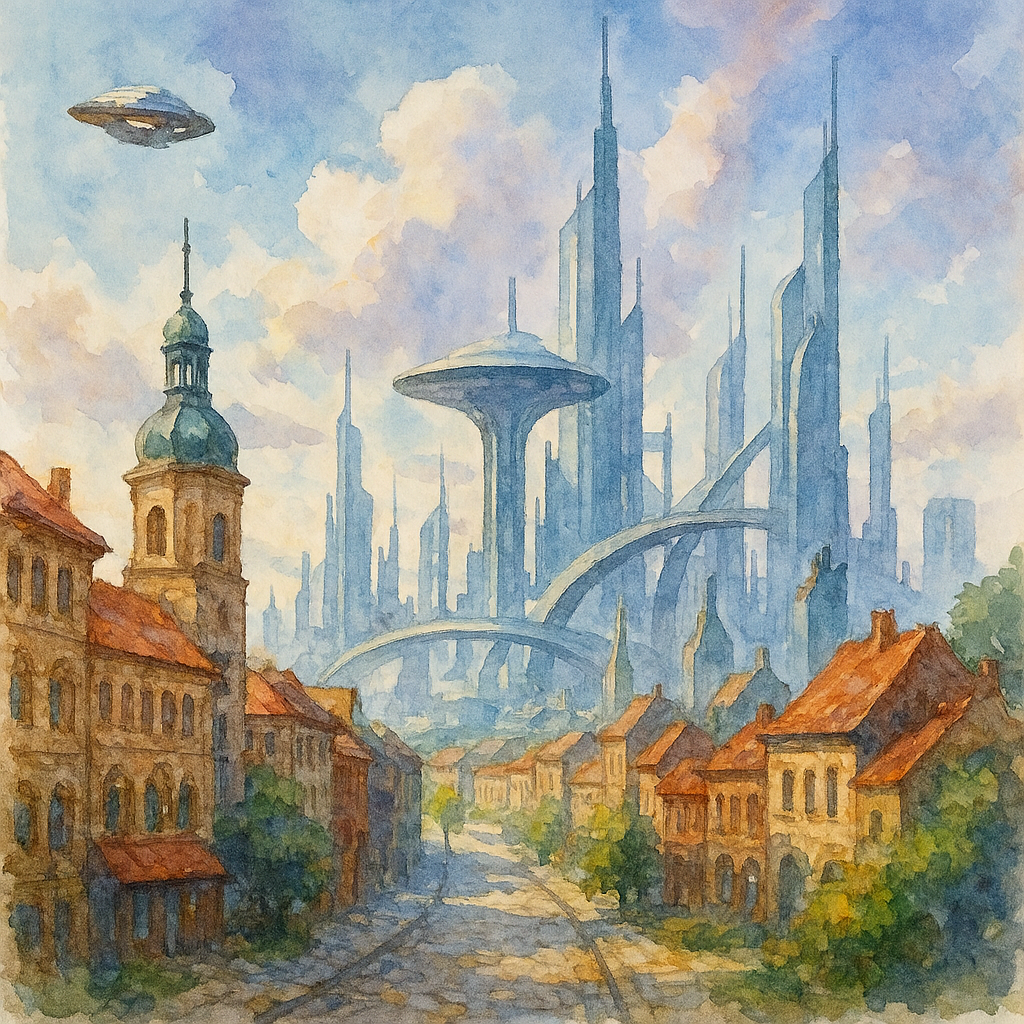
The Weight of Memory
Sora’s first designs were rebellious—towers that twisted away from traditional forms, streets that curved in defiance of the grid patterns that had governed cities for millennia. They dreamed of buildings that breathed, of spaces that adapted to human need rather than forcing humans to adapt to rigid structures.
But in quiet moments, pencil hovering over paper, they found their hand tracing familiar shapes. The arch of their grandmother’s doorway. The proportion of the temple where they first understood silence. The width of the alley where they learned that cities could be cruel.
“Am I building the future,” Sora wondered, “or am I simply rearranging the past with better materials?”
The City Takes Shape
The City of Tomorrow began to rise, and in its design, the struggle became manifest:
The Memory Gardens: Sora created spaces where the old was neither destroyed nor preserved, but transformed. Ancient stones became seats for contemplation, their weathered surfaces telling stories while supporting new purposes. Here, the past wasn’t escaped but metabolized.
The Adaptive Districts: Buildings with walls that could dissolve and reform, allowing neighborhoods to reshape themselves as communities evolved. Yet even this flexibility followed patterns—humans still gathered in certain ways, still needed the ancient comfort of hearth and threshold.
The Timeline Bridges: Walkways that connected not just spaces but temporal experiences—one could walk from a district maintaining traditional crafts directly into zones of radical experimentation. The bridges themselves became the philosophy: connection without erasure.
The Foundation Pools: Transparent floors in certain buildings revealed the archaeological layers beneath—Roman roads, indigenous gathering places, industrial pipes. Citizens walked daily on glass above history, neither trapped by it nor permitted to forget it.
The Dream and the Dance
As the city grew, Sora realized the question had been wrong from the beginning. It wasn’t about freedom from the past or dreams of the future—it was about the dance between them.
They discovered that every truly innovative solution carried within it the ghost of an ancient need. The vertical farms that fed the city? They followed patterns of terrace agriculture millennia old. The community pods where decisions were made? They echoed the circle of elders around fires that predated written history.
The City of Tomorrow became a living philosophy: that progress meant not the abolition of the past but its conscious integration. The builder’s freedom lay not in escape but in choice—choosing which threads of history to weave forward, which patterns to break, which foundations to build upon and which to leave as gardens for memory.
The Eternal Present
In the end, Sora stood in the city’s central plaza—a space that seemed to exist outside of time. Children played with holographic fountains while elderly citizens sat on benches carved from ancient olive trees. The past and future collapsed into an eternal present, each moment containing both memory and possibility.
The builder realized they had never been building tomorrow at all. They had been building today—the only moment where past and future meet, where dreams and foundations can coexist, where freedom means not the absence of history but the power to transform it into something new while honoring what it was.
The City of Tomorrow’s greatest innovation wasn’t its technology or design. It was its recognition that humans are temporal beings who carry their yesterdays into their tomorrows, and that any city worth building must make space for both the weight of memory and the lightness of dreams.
Sora’s final blueprint, left unsigned in the city archives, contained just one line: “We build not to escape time but to give it a home.”
The narrative suggests that perhaps the question itself—freedom from the past versus dreams of the future—presents a false dichotomy. The true architect of tomorrow understands that we build with the materials of memory even as we reach toward possibility, and that the most profound innovation might be learning to honor both without being imprisoned by either.

 Bhyllabus l'énigme
Tinggalkan komentar