
The Recipe Without a Name
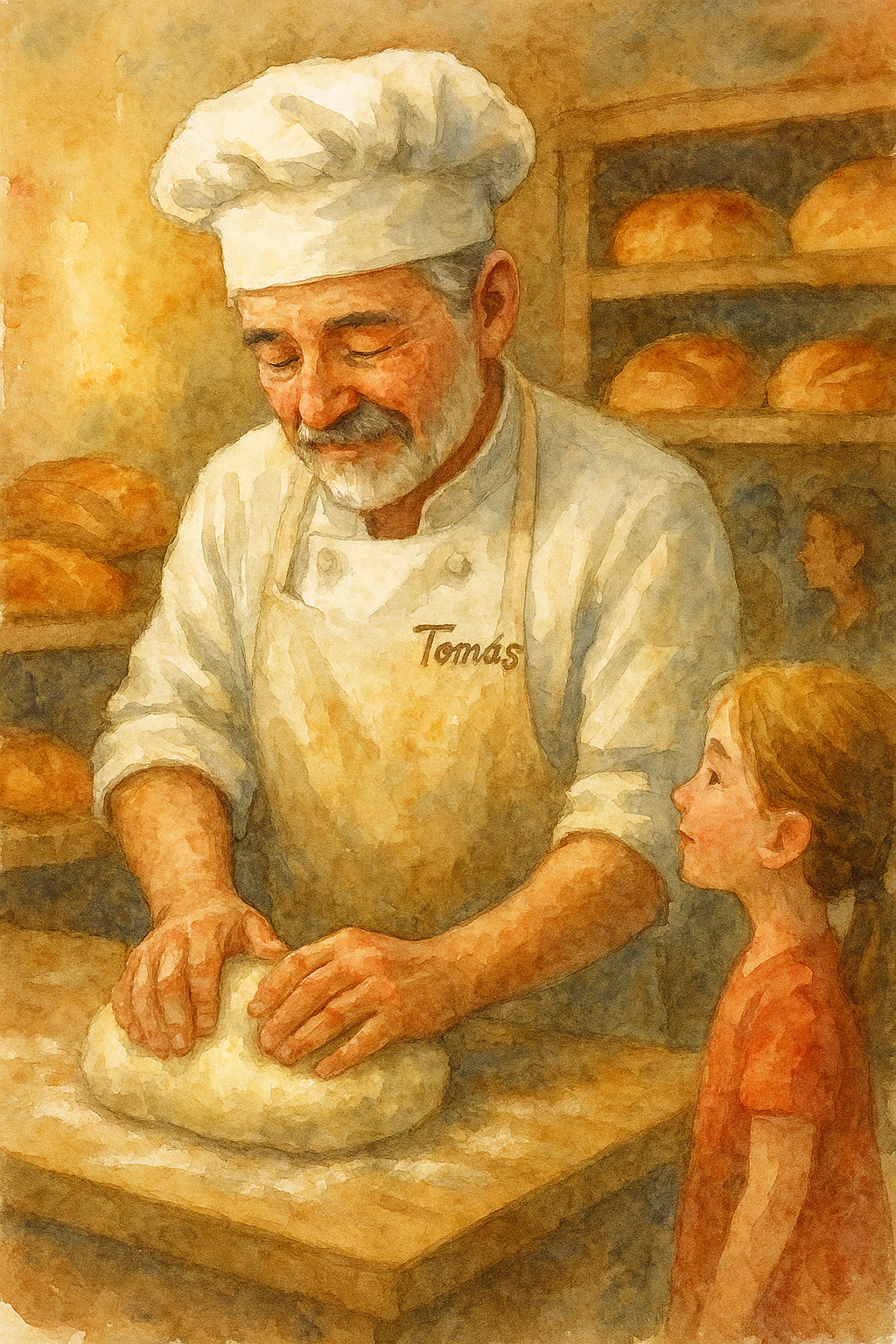
Tomás never wrote it down. Not once in forty years of cooking. The recipe lived in his hands—in the way his fingers knew exactly how much salt to pinch, how his wrist understood the precise angle for folding butter into flour, how his palms could feel when the dough had been kneaded just enough to hold memory but not so much that it forgot how to be tender.
It wasn’t complicated. That was the point. That had always been the point.
Flour. Butter. A single egg from his neighbor’s chickens that pecked at sunrise. Salt from the sea that touched the shore three miles from his kitchen. Water that had traveled through mountain stones. And the secret ingredient—though Tomás would laugh at calling it secret—time given freely, without counting.
The Morning Ritual
Each morning before the restaurant opened, before the complex sauces and the careful plating, before the critics and the customers, Tomás made his bread. Not for the menu. This bread had never appeared on any menu.
He worked in the blue hour before dawn, when the kitchen belonged only to him and the ghosts of every meal that had ever been cooked there. His hands moved in meditation, each gesture a prayer to simplicity. The kneading became a conversation with the dough—pushing away, pulling close, pushing away, pulling close—the eternal rhythm of all relationships that matter.
As he worked, he smiled. Not the practiced smile of service, but the involuntary curve of lips that comes when the body remembers joy. His grandmother’s hands guiding his when he was seven. The first time he’d made someone laugh with surprise at how something so simple could taste like home.
The Philosophy of Crust
“Why this bread?” his sous chef once asked, watching Tomás shape the dough with the devotion usually reserved for sacred things. “You could make brioche, sourdough, focaccia—bread that would win awards.”
Tomás paused, his flour-dusted hands suspended above the counter like birds deciding whether to land. “Those breads are about the baker’s skill,” he said finally. “This bread is about the eating.”
He couldn’t explain that complexity was its own kind of wall. That when food became too elaborate, it became about admiration rather than nourishment, about the distance between chef and diner rather than the closing of that gap. This bread—plain, honest, warm—was a bridge. It said: we are the same, you and I. We hunger, we eat, we smile.
The Transformation
The magic happened in the giving.
The businesswoman who entered tight-lipped, phone pressed to ear, arguing about margins and markets. Tomás brought her the bread—no plate, just the torn piece in a simple cloth, still steaming. She paused mid-sentence. Bit. Closed her eyes. When she opened them, she was eight years old for just a moment, remembering her mother’s kitchen, Sunday mornings, the luxury of nowhere to be.
The widower who ate alone every Friday, ordering the same soup, reading the same worn paperback. The bread appeared beside him without ceremony. He looked up, surprised—he hadn’t ordered it. “From the kitchen,” the server would say. The man would break the bread slowly, as if it were communion, and for the first time that week, he’d smile at a stranger.
The child afraid of trying new foods, whose parents apologized endlessly for their pickiness. Tomás would emerge from the kitchen—a rare appearance—and kneel beside the small skeptic. “This is magic bread,” he’d whisper conspiratorially. “But the magic only works if you close your eyes on the first bite.” The child, enchanted by conspiracy, would comply. And in that darkness, with only taste to guide them, they’d discover that joy could be simple, that not everything unknown was frightening.
The Economy of Happiness
Tomás never charged for the bread. His accountant despaired. “You give away hundreds of euros worth of ingredients each month!”
But Tomás understood a different economics. He knew that happiness operated on principles that defied ledgers. That a smile, genuine and surprised, created a currency that multiplied rather than depleted when spent. That in a world growing heavy with complexity, the weight of simple kindness could tip scales in ways that mattered more than money.
Each piece of bread was an investment in the possibility that people might remember: joy doesn’t require much. Just flour, water, salt, and someone who cares enough to transform them.
The Recipe Shared
Years later, when Tomás’s hands grew too trembling to knead, a young cook asked him to finally write down the recipe. She’d watched him make it a thousand times but could never quite capture the same warmth, the same inexplicable rightness.
Tomás took the pen, and wrote:
“Use your hands, not machines. The warmth matters. Add flour until it feels like summer earth. Salt like tears of joy—present but not overwhelming. Knead until your arms tire, then knead a minute more. Let it rise in a warm place, like hope does. Bake until it sounds hollow when tapped, like a good joke. Break it, never cut it. Share it, never sell it. Watch their faces. That’s the recipe.”
The Last Loaf
On his final morning in the kitchen, Tomás made twelve loaves. Eleven he gave away—to the fishmonger who brought his best catch, to the woman who delivered vegetables, to the rival chef across the street who thought no one knew he came for coffee at dawn, to strangers who happened to pass the kitchen door.
The twelfth he kept. Sitting in his empty restaurant after everyone had gone, he broke the bread slowly, tasting forty years of morning rituals, of small transformations, of the decision made daily to believe that happiness was not a complex dish requiring rare ingredients and perfect technique, but something as basic and essential as bread.
He smiled—that same involuntary curve of lips. Tomorrow someone else would make the bread. It wouldn’t taste exactly the same. That didn’t matter. What mattered was that they would make it, that they would give it, that somewhere someone would pause in the middle of their complicated life and remember, for just a moment, that joy could be this simple.
Epilogue: The Continuation
The restaurant still serves elaborate food that wins awards. But every morning, before the complexity begins, someone makes Tomás’s bread. The recipe, now framed in the kitchen, is consulted like scripture by new cooks who don’t yet understand why the simplest thing they make is the most important.
But they learn. They learn the first time they carry that warm, torn piece to someone who has forgotten that happiness doesn’t always require reasons, that sometimes it arrives in the most basic of forms—flour, water, salt, and the knowledge that someone, somewhere, took the time to make something not because it was profitable or impressive, but because it might make you smile.
And in that smile—quick, surprised, genuine—lives the entire philosophy of Tomás’s kitchen: that we feed each other not just to sustain the body but to remind the soul that it belongs to a species capable of transforming the simplest ingredients into joy.
The bread has no name because it needs none. It is the taste of small happiness, the flavor of connection, the texture of a truth so basic we forget it daily and must be reminded: that the best things we can offer each other are often the simplest, given freely, with no expectation except the hope that for a moment, we might smile together.
In every kitchen now touched by this tradition, young cooks learn that mastery isn’t about complexity but about understanding when simplicity is the deepest gift. They learn that a smile—honest, surprised, grateful—is both the smallest and largest thing a cook can create. And that sometimes, the favorite recipe isn’t about the food at all, but about the space it makes for happiness to enter, simple and warm as bread.
 Bhyllabus l'énigme
Tinggalkan komentar