
The First Silence
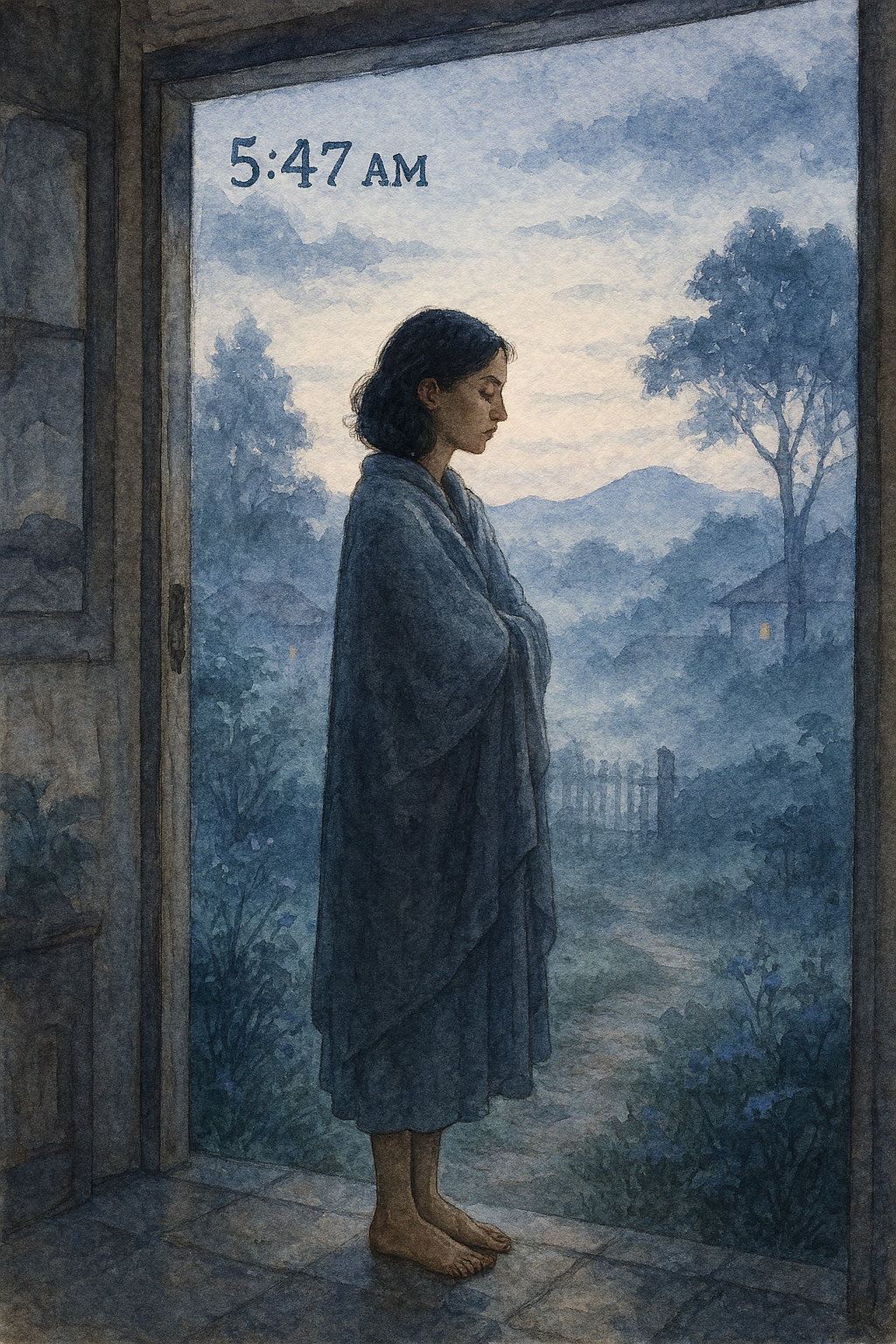
For years, Putri believed her favorite time was 5:47 AM.
Not 5:45—too conscious of its rounded perfection. Not 6:00—too obvious in its declaration of morning. But 5:47, when the world hung suspended between night’s last breath and day’s first inhale, when time itself seemed to forget its purpose for exactly thirteen minutes.
She would slip from bed with the practiced stealth of someone protecting something sacred, bare feet finding the cold floor like a baptism. The house held its sleeping breath—children dreaming in tangled sheets, her husband’s hand still curved around the ghost of where she’d been lying.
This was her hour. The kitchen window framed a world painted in indigo and silver, colors that had no names in daylight. She didn’t make coffee yet—that would break the spell with its domestic urgency. Instead, she stood at the threshold between house and garden, neither inside nor out, and let herself dissolve.
In this hour, Putri wasn’t mother, wife, teacher, daughter. She wasn’t even Putri. She was the space between heartbeats, the pause between thoughts. She was possibility without the burden of choice. The sparrows hadn’t begun their territorial arguments. The neighbor’s dog hadn’t remembered it had opinions about passing cars. The world was soft, unformed, forgiving.
She would watch the darkness thin like watercolor paint, revealing the bones of trees, the suggestion of fence posts, the rumor of mountains in the distance. This was her meditation—not emptying the mind but filling it with the kind of silence that had texture, weight, presence. The silence that reminded her she existed separate from her roles, her loves, her obligations.
Some mornings she wrote in a journal that no one would ever read—not secrets, just observations too delicate for daylight. The cat moves through the garden like liquid shadow. The first bird sounds uncertain, as if asking permission. I am here, I am here, I am here.
The Discovery
It was on a Thursday—she remembered because Thursdays had swimming lessons and rushed dinners—that Putri realized she’d been wrong about her favorite time.
Miguel had found her in the garden at 5:47, wrapped in the blanket she’d claimed as her morning uniform. She’d startled, ready to defend her solitude, to explain why she needed this pocket of alone-time before the day demanded everything.
But he hadn’t come to retrieve her to duty. He’d brought his own mug, his own silence. He sat on the opposite end of the bench, far enough that they were two separate solitudes, close enough that she could feel the warmth of another human choosing quiet beside her.
They didn’t speak for seven minutes. The garden held them both without question.
Finally, he said, “I used to watch you from the window sometimes. You looked like you were praying.”
“I was,” Putri said, though she’d never thought of it that way. “To nothing. To everything.”
“I know,” he said. And somehow, impossibly, he did.
The Descent of Evening
That’s when Putri discovered her second favorite time: 8:23 PM.
Again, the specificity mattered. After dinner’s democracy of needs and voices, after homework’s small battles, after baths and stories and the negotiation of one more glass of water. After the house had been restored to some semblance of order, but before the evening dissolved into the separate worlds of screens and sleep.
8:23 PM was when she and Miguel found each other on the back porch, where the day pooled in golden honey light, where the air held the memory of warmth without its weight. This wasn’t the mystical silence of dawn but something else—a comfortable quiet built from twenty years of conversations, where words had become optional, where presence was the whole language.
Sometimes they talked—about the children’s small dramas, about work’s absurdities, about nothing that would matter in a month. Sometimes they played cards with the lazy competition of people who’d forgotten who won the last hundred games. Sometimes they just sat, her feet in his lap, his hand absent-mindedly tracing the architecture of her ankle, both reading different books but breathing in the same rhythm.
This hour wasn’t about transcendence or dissolution. It was about the profound ordinariness of shared time, the luxury of another person who didn’t need you to be anything but adjacent and alive.
The Philosophy of Two Loves
Putri began to understand that humans are built for this contradiction—the need to disappear and the need to be seen, the hunger for solitude and the hunger for connection. Neither canceled the other; both were true, both were necessary, like inhaling and exhaling, like winter and summer, like silence and song.
Her morning time was vertical—it connected her to something above and below daily life, to the eternal part that existed before she was Putri and would exist after. It was the time when she belonged to herself, or perhaps to the universe, or perhaps those were the same thing.
Her evening time was horizontal—it connected her to the person she’d chosen to walk beside, to the specific and temporal beauty of this life, these years, this love that wouldn’t last forever but was therefore infinitely precious. It was the time when she belonged to the story they were writing together, word by word, day by day.
The Dance of Hours
The children grew and eventually noticed both rituals. “Why do you get up so early?” her daughter asked, catching Putri returning from her morning sanctuary.
“To remember who I am,” Putri said.
“Don’t you know?”
“I forget sometimes, in the loving of other people. So I need a little time to find myself again.”
“And why do you and Papa sit outside every night?”
“To remember who we are together.”
“Don’t you know that either?”
“We forget sometimes, in the business of living. So we need a little time to find each other again.”
Her daughter nodded as if this made perfect sense, which perhaps at twelve, it did.
The Seasons Turn
Years passed. The 5:47 AM sometimes became 5:15 when insomnia offered extra solitude, or 6:30 when exhaustion demanded more sleep. The 8:23 PM sometimes became 9:00 when dinner ran late, or 7:45 when summer light stretched the day like taffy.
But the two times remained, stubborn in their necessity. Even when Miguel traveled, Putri kept the evening appointment, holding space for his absence. Even when Putri was sick, she dragged herself to the morning window, if only for five minutes of that particular silence.
She understood now that love—real love, sustainable love—required this paradox. You needed to belong completely to yourself before you could truly give yourself to another. You needed solitude to make companionship a choice rather than a desperate escape from loneliness. You needed your own favorite time to appreciate the shared one.
The Recognition
One winter morning, the kind where 5:47 arrived in complete darkness, Putri found a note on the kitchen counter in Miguel’s handwriting:
“Your morning time is sacred. I know this. But I wanted you to know—watching you return from it, seeing you walk back into our life carrying that peace with you, that might be MY favorite time. The moment when you choose to come back to us, full of whatever you find in that silence. Thank you for both—for going and for returning.”
That evening at 8:23, she told him, “I never loved you more than when you sat beside me that first morning and said nothing. When you knew to be near but not intrusive. When you understood that loving someone sometimes means loving the space around them too.”
The Truth of Time
Putri learned that we don’t have one favorite time but many, each serving different hungers. The hunger for transcendence and the hunger for groundedness. The hunger for infinity and the hunger for specificity. The hunger to be empty and the hunger to be full.
She learned that the deepest love stories aren’t just about two people finding each other but about two people helping each other find themselves. That the best relationships have three entities: you, me, and us. Each requires its own time, its own attention, its own favorite hour.
The Final Hour
Decades later, when Miguel was gone and the house held different silences, Putri still kept both appointments. At 5:47 AM, she found herself in that eternal present where she was ageless, timeless, just consciousness watching the world wake. At 8:23 PM, she sat on the porch and felt him there—not as a ghost but as an echo, the way a bell’s ring continues in the air after the bronze stops moving.
Her granddaughter, visiting, asked, “Grandma, which is really your favorite time?”
Putri smiled, understanding finally the question she’d been answering all her life. “Both, my dear. Always both. We need the time when we belong only to ourselves, and we need the time when we belong to each other. Like a heartbeat—the solitary chamber filling with blood, the connected chamber sending it out to the world. Both movements make us alive.”
Epilogue: The Inheritance
Now Putri’s children have their own sacred times. Her son rises at 4:30 to run in darkness, finding himself in the rhythm of his breath. Her daughter sits in her car for ten minutes after coming home from work, music off, engine cooling, gathering herself before entering her beautiful, chaotic life.
And in the evenings, they find their partners. On porches, in kitchens, on walks around the block. They create that second favorite time, the one that says: of all the people in the world, I choose to be quiet with you. To watch the light change with you. To do nothing that matters and everything that does, with you.
They’ve learned what Putri learned: that the favorite time isn’t about the hour on the clock but about the quality of presence. That we need both the alone and the together, the silence and the sharing, the time when we are everything and the time when we are part of something.
They’ve learned that love is not choosing between these times but honoring both—the vertical reach toward eternity and the horizontal reach toward each other. The time when we remember we are infinite and the time when we celebrate being beautifully, temporarily, specifically here.
In the end, the clock holds all hours equally, but we don’t. We mark certain moments as sacred—some for solitude, some for sharing. And in this marking, in this choosing, we write the real story of our days: that we are creatures of both aloneness and togetherness, and our favorite times are the ones that honor both truths, like morning and evening, like breathing in and breathing out, like the silence before the first word and the silence after the last, both perfect, both necessary, both loved.
 Bhyllabus l'énigme
Tinggalkan komentar