
Part I: The Age of First Light (1995-1999)
Remember the sound? That screech and static symphony of dial-up, like some electronic shaman calling forth spirits from copper wire. We’d sit before glowing screens—hulking CRT monitors that hummed with possibility—waiting for the handshake between worlds to complete.
You’ve Got Mail.
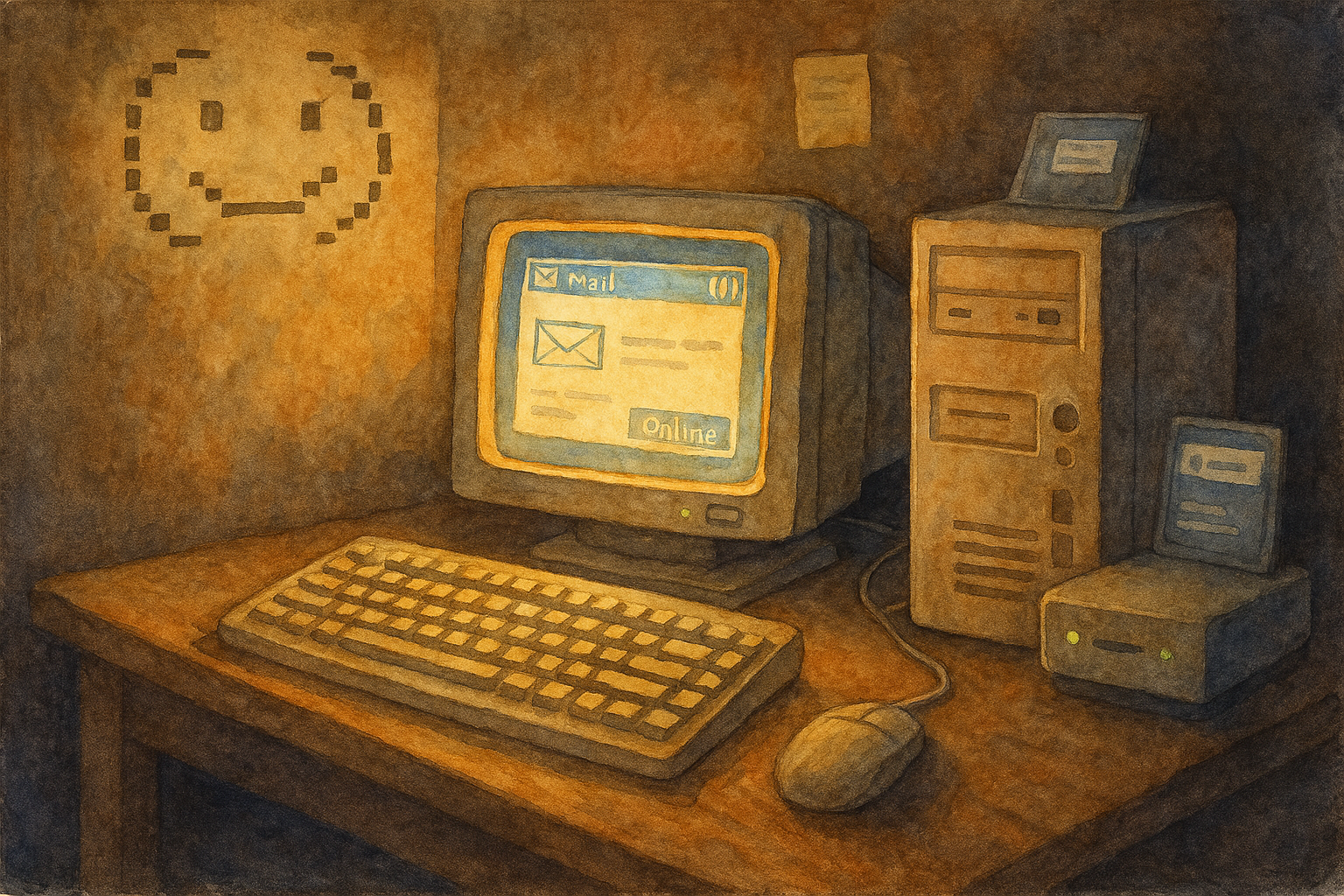
Three words that carried the weight of miracle. Someone, somewhere, had thought of you. Had typed letters into light and sent them across impossible distances. We’d check our inboxes obsessively, refreshing Netscape Navigator with the patience of gardeners waiting for rain. Each email was composed with the gravity of a handwritten letter, yet arrived with the speed of thought.
In IRC channels, we were pioneers in digital caves, our words appearing in pure text—green on black, white on blue—stripped of every pretense except what we could build with ASCII art and carefully chosen words. We were CyberDude91 and MoonGirl_23, inventing ourselves with each keystroke, but somehow more honest in our anonymity than we’d ever learn to be with our real names attached.
ICQ’s “Uh-oh!” became the soundtrack of a generation learning to exist in two places at once. That little flower blooming on our desktops meant someone wanted to talk—right now, immediately, across oceans and time zones. We’d stay up until 3 AM, typing to strangers who became friends, friends who became lifelines, our keyboards clicking like prayer wheels spinning out new kinds of intimacy.
We thought we were just chatting. We didn’t know we were building the blueprint for human connection’s future—and perhaps its cage.
Part II: The Broadcasting of the Self (2000-2009)
Then came the blogs, and suddenly everyone was a publisher. LiveJournal, Blogger, WordPress—platforms that whispered: Your thoughts matter. Your life is content. Broadcast yourself.
We wrote with the earnestness of diarists who’d accidentally left their journals open in the town square. Every mundane detail became potentially significant. What we ate for breakfast. The song that made us cry. Our political awakening at 2 AM. We tagged our posts meticulously, creating taxonomies of our own existence: #personal #rants #dreams #quarter-life-crisis.
Friendster arrived like a revelation—here was a map of our connections, visible, quantifiable. Six degrees of separation collapsed into clickable links. We crafted our first profiles with the attention of Renaissance painters, choosing which bands defined us, which books made us seem interesting, which photo captured our essence (always slightly blurry, always from above).
MySpace taught us HTML through vanity. We’d spend hours customizing our profiles—autoplay music that assaulted visitors, glittering GIFs, backgrounds that made our text unreadable but looked so cool. Tom was everyone’s friend, the first hint that friendship online meant something different than we’d thought.
Then Facebook arrived in 2004, clean and exclusive, requiring a college email like a digital velvet rope. We rushed to join, to exist in this new space where our lives could be summarized in relationship statuses and wall posts. The poke—what did it mean? Everything. Nothing. A digital gesture so abstract it became philosophy.
We didn’t notice when we stopped being users and became products. The shift was subtle, like the tide coming in while you’re building sandcastles.
Part III: The Multiplication of Selves (2010-2019)
Twitter demanded we compress our souls into 140 characters, then graciously expanded to 280, as if those extra characters could contain what was spilling over. We learned to think in tweets, our consciousness fragmenting into shareable chunks. The retweet became our new currency—thoughts weren’t just ours anymore but collective property, spreading like viruses or wildfire, depending on your perspective.
Instagram arrived, teaching us that life wasn’t lived but performed. Every moment became potentially aesthetic. We’d arrange our food before eating, waiting for the perfect light. We’d take forty-seven photos to find the one that looked “candid.” Valencia, X-Pro II, Mayfair—filters that could make our ordinary lives look extraordinary, vintage, dreamy. We began to see the world through squares, cropping out whatever didn’t fit the frame.
LinkedIn forced us to transform our struggles into “journey narratives,” our failures into “learning experiences.” We congratulated each other on work anniversaries at jobs we hated, endorsed skills we’d never seen each other use. Professional networking became performance art where everyone pretended their career was a TED talk waiting to happen.
And somewhere in this multiplication, we lost track. Who was the real person? The witty Twitter personality? The aesthetic Instagram curator? The professional LinkedIn networker? The Facebook family person? The Reddit commenter with strong opinions about everything? We became Method actors who’d forgotten we were acting, each platform demanding a different performance until we were a scattered constellation of selves, no longer sure which star was the sun.
Part IV: The Great Unraveling (2015-Present)
The algorithms learned us better than we knew ourselves. They fed us what we wanted before we knew we wanted it, trapped us in echo chambers so comfortable we forgot they were prisons. The infinite scroll became our Sisyphean task—always more content, always another video, always one more notification to check.
Truth became negotiable. Facts became opinions. Opinions became facts. The battleground wasn’t just ideas anymore but reality itself. We watched in real-time as conspiracy theories bloomed like toxic algae, as disinformation spread faster than corrections, as deep fakes made us question every image, every video, every piece of evidence our eyes provided.
We’d argue with strangers about things that mattered desperately for three hours, then forget what we’d been fighting about by dinner. Outrage became our caffeine, keeping us alert, engaged, exhausted. We’d doom-scroll through catastrophes, each swipe bringing fresh horror, unable to look away from the feeds that fed on our anxiety.
The pandemic arrived and the digital world swallowed what remained of the physical. Zoom backgrounds replaced real rooms. Virtual meetings replaced human presence. We worked from home but lived at work, the boundaries dissolved in the acid of constant connectivity. Children attended school through screens, learned to read facial expressions through pixels, celebrated birthdays in digital rooms where no one could hear anyone sing in unison.
Part V: The Search for Oases
Now we speak of “digital detoxes” like Victorian ladies taking the cure at seaside sanitariums. We download apps to limit our apps, use technology to escape technology. We’ve become digital ouroboros, consuming ourselves in an endless cycle of refresh and regret.
Some of us maintain multiple accounts like Russian nesting dolls—the public one, the private one, the anonymous one, the professional one, the one where we pretend to be someone else entirely, the one where we try to remember who we were before all this started. We’ve become our own social media managers, curating our existence for audiences we’ll never meet.
The young ones, the digital natives, navigate this like fish in water, not knowing there was ever a shore. They speak in memes, communicate in TikTok dances, exist in Discord servers more real than their classrooms. They’ve never known a world where they weren’t performing, being watched, generating content from their very existence.
And yet, in the exhaustion, something shifts. We begin to recognize the prison bars. Some delete their accounts in dramatic digital suicides, only to resurrect weeks later, unable to exist in the social void. Others limit, moderate, boundaries drawn like battle lines against the attention merchants.
We rediscover blogs—now called newsletters—writing longer thoughts for smaller audiences, quality over virality. We join small Discord servers or Telegram groups, digital speakeasies where we can drop the performance. We share photos that delete themselves, embracing impermanence over the permanent record of our mistakes and meals.
Part VI: The Nostalgic Future
Sometimes, late at night, we remember that first email, that first ping of connection across the void. We remember when “online friends” was a suspicious phrase, before it became the only kind many of us had. We remember when going online was a choice, an event, not the default state of existence.
The internet we dreamed of—a library of Alexandria, a global consciousness, a tool for human liberation—exists alongside the internet we built—a panopticon, a manipulation machine, a hall of mirrors where we’ve lost track of which reflection is real.
But here’s the truth we discovered in our digital wandering: we were always performing. The internet didn’t create our multiple selves; it revealed them. We always curated our personalities for different audiences, wore masks for different occasions. The digital world just made the masks visible, gave us metrics for our performances—likes, shares, views, the applause we always craved made countable.
Epilogue: The Space Between Heartbeats
Now, in 2025, we exist in the pause between what was and what will be. AI chatbots write our emails while we struggle to remember how to write letters. We’ve taught machines to speak like humans while forgetting how to listen to each other. We’re more connected than ever and lonelier than we’ve ever been.
Yet in the spaces between the noise—in the two-factor authentication pause, in the loading screen moment, in the brief second before the notification arrives—we sometimes remember what we were searching for when we first logged on: connection, understanding, the feeling that somewhere in the vast digital darkness, another consciousness was reaching back toward us.
We learned that every technology is a pharmakon—both poison and cure, both prison and key. The same screens that separate us from the world also open windows to it. The same algorithms that trap us in bubbles also help us find our tribes. The same platforms that exhaust us with performance also let us witness each other’s lives across impossible distances.
We stand now at the terminal, thirty years into this experiment, understanding that we’re not going back. The question isn’t whether to be online or offline—that binary dissolved years ago. We’re cyborgs now, our minds extended into cloud storage, our memories outsourced to Google Photos, our relationships maintained by notification systems.
The real question is: How do we remain human in the machine? How do we find truth in the age of infinite truths? How do we maintain authentic connection when authenticity itself has become a brand?
Perhaps the answer lies not in escape but in intentionality. In choosing our platforms like we choose our homes. In crafting our digital selves with the same care we bring to our physical selves. In remembering that behind every avatar, every handle, every profile is a human being, sitting alone at a keyboard, trying to be heard, trying to be seen, trying to be real.
The oases exist. They’re in the group chats where we drop our masks. In the video calls where someone’s cat walks across the keyboard and everyone laughs. In the comments sections where strangers offer genuine support. In the moments when someone across the world understands exactly what you mean, despite the pixels and protocols between you.
We built this labyrinth together. We can build the thread that leads out—or perhaps more honestly, the threads that help us navigate within it. Because there is no outside anymore. There’s only the continuous work of being human in the digital age, of finding each other in the noise, of remembering that every notification is just someone else, equally lost, equally searching, reaching out across the electric void, hoping for connection.
You’ve got mail.
It still matters. It still means someone thought of you. We just have to remember to think back.
And so we continue, refreshing our feeds like prayer wheels, hoping each spin might bring enlightenment instead of engagement, connection instead of content, truth instead of trending topics. We are the transitional generation—the ones who remember Before and must navigate After. We carry both the nostalgia for simplicity and the addiction to complexity. We are the bridge between the analog and digital souls, and our burden is to remember both, to honor both, to somehow synthesize both into something new, something human, something real—even if we’re not quite sure what “real” means anymore in this age of infinite versions of ourselves, scattered across servers like stars across the dark.
 Bhyllabus l'énigme
Tinggalkan komentar