
I. The Noble Parliament’s Comedy
A Satirical Narrative
Behold! What light through yonder parliament breaks? ‘Tis not the sun, but golden allowances that shine! For in this blessed realm where children sup on dreams and mothers count their tears for sustenance, our noble legislators have discovered the most pressing need of all—fifty million rupiah monthly for their tender housing needs.
Oh, what exquisite mathematics these learned men employ! Twenty times the peasant’s wage they claim, and yet they sleep not on beds of guilt but cushions stuffed with justification. “The prices of Jakarta,” they cry, “have risen with the times!” Aye, risen indeed—like smoke from tear gas canisters, like the wails of mothers whose sons return home bloodied, like the cost of dignity in a land where justice is auctioned to the highest bidder.
What sweet irony doth providence provide! That those who craft the laws of want should want for nothing, whilst those who break their backs in service to the nation break upon the stones of indifference. The very halls where democracy should flourish have become tombs of hope, echoing not with the voice of the people, but with the hollow ring of coins counted in chambers far from the streets where blood now flows.
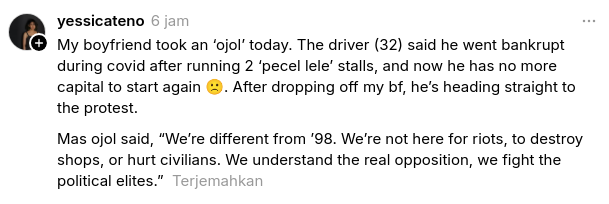
And when the people—those quaint, unreasonable folk—dare voice their discontent, what remedy do our wise guardians provide? Not bread, but batons. Not justice, but the sweet symphony of water cannons. For nothing soothes the hunger of the soul quite like the baptism of riot shields and the communion of tear gas that burns the eyes to cleanse them of dangerous visions.
II. Sonnet of the Streets
Upon the Deaths in Jakarta’s Protests
When rage and sorrow mate in lovers’ dance,
And birth their child upon the bloodied stones,
What cursed stars align in such mischance
That mothers weep alone above fresh bones?
The parliament sits fat while people starve,
Their allowances bloom like poisoned flowers,
While common folk their meager bread must carve
From scraps thrown down from ivory towers.
O Death, thou democratic reaper, see—
Thou takest poor and rich without regard,
Yet still the scales of justice bend their knee
To golden weight that makes compassion hard.
So let these verses be the people’s voice,
When power leaves the powerless no choice.
III. The Fool’s Soliloquy
After Hamlet’s “To be or not to be”
To rage, or not to rage—that is the question:
Whether ’tis nobler in the mind to suffer
The slings and arrows of outrageous fortune
Dealt by those who feast while children hunger,
Or to take arms against this sea of troubles
And by opposing, bleed upon the street?
To die, to sleep—perchance to wake in lands
Where legislators earn their silver honestly,
Where tear gas is not the people’s perfume,
Where batons are not democracy’s answer
To the inconvenience of angry hearts.
For who would bear the whips and scorns of power,
The oppressor’s wrong, the proud man’s contumely,
The pangs of disprized love of country,
The law’s delay, the insolence of office,
And the spurns that patient merit takes
From unworthy men in worthy seats,
When he himself might his quietus make
With a bare bodkin? Who would fardels bear,
To grunt and sweat under a weary life,
But that the dread of something after death—
The undiscovered country, from whose bourn
No traveler returns—puzzles the will,
And makes us rather bear those ills we have
Than fly to others that we know not of?
IV. The Merchant of Sorrow
A Brief Tragedy
Chorus:
In fair Jakarta, where we lay our scene,
From ancient grudge break to new mutiny,
Where civil blood makes civil hands unclean.
From forth the fatal loins of these two foes—
The people’s hunger and the rich men’s greed—
A pair of star-crossed lovers take their life:
Hope and Justice, buried in the street.
The People:
We are but players, poor and brief,
That strut and fret our hour upon the stage
Of history’s vast theater.
Our grief Writes itself in blood upon each page
Of this grand book where future men will read
How power corrupts, and greed plants its seed.
The State:
Peace, ho! We offer you such sweet repose—
The peace of graves, the silence of the tombs.
For every protest that against us grows,
We have an answer that forever dooms:
The chemistry of gases, tears, and pain,
Until your voices shall not rise again.
The Dead:
But soft! What voice through yonder graveyards breaks?
‘Tis conscience, and the people are the sun!
Arise, fair justice, and kill the envious shades
Of greed that pale at honor’s blazing gun.
Though we lie cold, our blood still speaks of shame
That burns in every mother’s whispered name.
V. Final Chorus: The People’s Epilogue
So here we stand, between the earth and sky,
Our hearts too full for tears, too proud for peace.
The powerful play goes on, and we—we die
For daring to demand that suffering cease.
Yet in our death, perhaps some seed takes root
In soil made rich by sacrifice and truth.
Let future poets sing of Jakarta’s streets,
Where common folk wrote history in blood,
Where democracy its children greets
With cannons’ roar and the authoritarian flood.
But mark this well, ye who hold power dear:
The dead still vote with every falling tear.
 Bhyllabus l'énigme
Tinggalkan komentar