
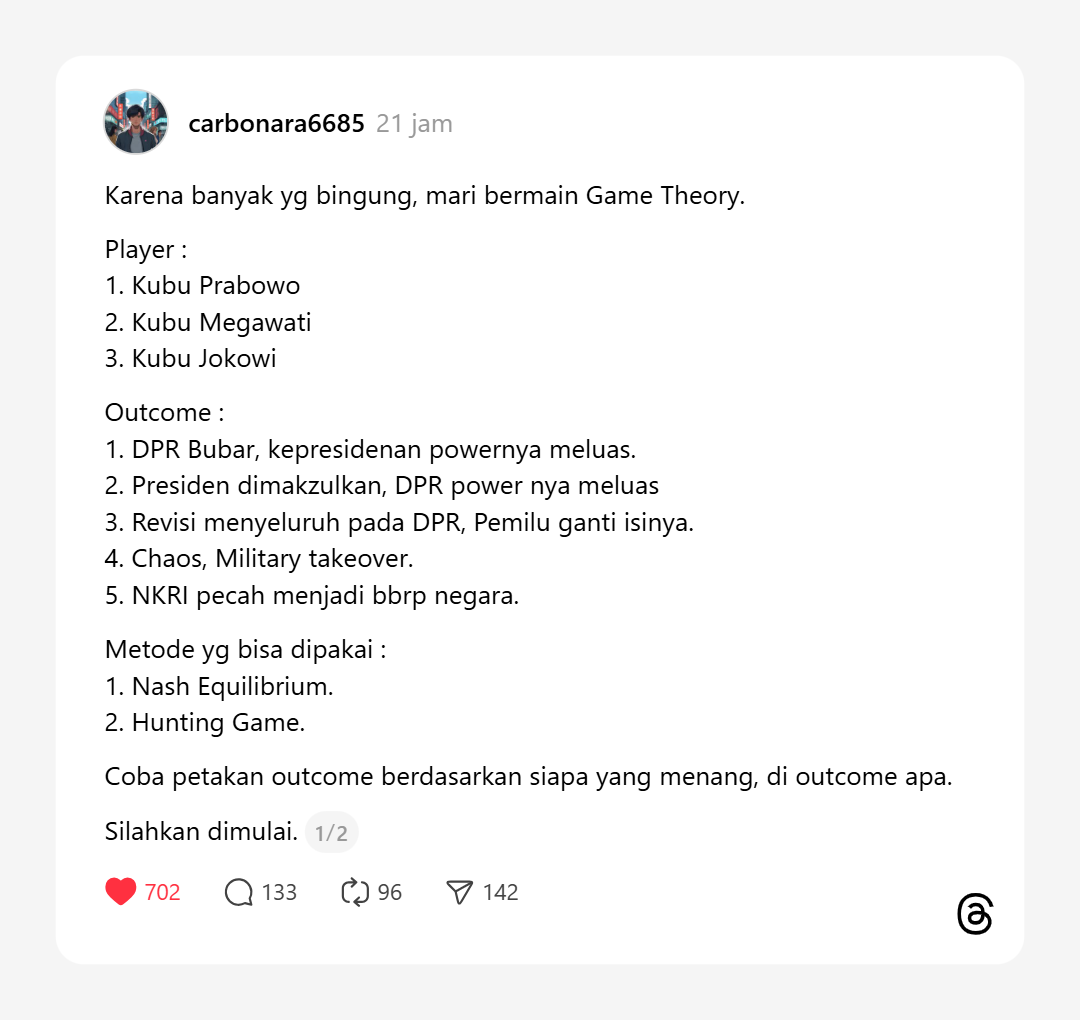
President Prabowo Subianto’s administration faces a complex three-way political competition where institutional dominance masks underlying fragilities, while military re-entry into civilian governance and regional separatist pressures create multiple pathways toward either democratic consolidation or systemic breakdown. This analysis reveals how current political tensions between Kubu Prabowo, Kubu Megawati, and Kubu Jokowi could evolve into five distinct scenarios through strategic interactions that fundamentally reshape Indonesia’s post-1998 democratic framework.
The 2024 electoral realignment created an unprecedented political configuration where the winning coalition controls over 80% of parliament yet operates within a system of divided loyalties, institutional manipulation, and external pressures that threaten both democratic governance and national unity.
Current strategic positions and power asymmetries
Kubu Prabowo operates from a position of overwhelming institutional dominance but faces critical vulnerabilities. The camp controls the presidency, defense ministry, and a “permanent coalition” encompassing 6 of 8 major parties, while the March 2025 TNI Law amendments have restored active military officers to civilian roles for the first time since Suharto. However, this apparent strength masks internal contradictions. Prabowo must manage tensions with retained Jokowi appointees across the security apparatus, handle growing public opposition to military expansion, and address massive corruption scandals including the $12 billion Pertamina fuel fraud case.
The camp’s strategic advantages include consolidated executive power through 48 ministries, control of the new Danantara sovereign wealth fund worth $900 billion, and extensive regional electoral victories. Yet Prabowo’s age (73) creates succession uncertainties, while military veterans’ demands for Vice President Gibran’s removal demonstrate elite resistance to Jokowi family influence.
Kubu Megawati maintains the strongest opposition position despite isolation. PDI-P’s 110 parliamentary seats make it the largest single party, providing symbolic leadership through DPR Speaker Puan Maharani. The camp’s strategic calculation centers on whether to maintain principled opposition or seek accommodation with Prabowo’s government. Megawati’s April 2025 meeting with Prabowo signals potential tactical cooperation, while internal factional disputes between accommodating (Puan Maharani) and oppositional (Prananda Prabowo) wings reflect strategic uncertainty.
The camp retains traditional strongholds in Central Java and Bali, controls secular nationalist networks, and benefits from Prabowo’s clemency grants to PDI-P figures just before the party congress, suggesting mutual interest in reducing tensions. However, their strategic vulnerability lies in complete exclusion from government resources and patronage networks.
Kubu Jokowi operates as a fragmented network maintaining shadow influence despite formal exclusion from both the presidency and PDI-P. The camp’s strategic assets include high personal popularity (75-80%), extensive bureaucratic networks from ten years in power, and family positioning through Vice President Gibran. Key strategic tension emerges from dual loyalty among retained appointees who must balance Jokowi connections with current Prabowo allegiance.
The camp faces the strategic dilemma of maintaining relevance without triggering open confrontation with Prabowo, while managing resistance from military figures demanding Gibran’s removal and navigating corruption investigations targeting Jokowi-era projects.
Military as strategic wildcard and institutional kingmaker
The Indonesian military’s expanded role creates the most significant strategic uncertainty in the current system. The March 2025 TNI Law represents the most dramatic reversal of post-1998 civilian supremacy, allowing active officers in 14 government institutions including courts and prosecution services. This legal framework provides justification for military intervention in political crises while creating institutional incentives for expanded military influence.
Current military leadership reflects divided loyalties that could prove decisive in crisis scenarios. TNI Commander General Agus Subiyanto was appointed by Jokowi, Army Chief General Maruli Simanjuntak is son-in-law of Jokowi ally Luhut Pandjaitan, while Defense Minister Sjafrie Sjamsoeddin represents Prabowo’s military network. This division means the military cannot be reliably counted on by any single political camp, making it a potential arbiter in confrontations.
The April 2025 retired generals’ crisis, where 330 former officers demanded Gibran’s removal, demonstrates how military networks can independently pressure civilian leadership. The attempted reshuffle of active officers and its partial reversal reveals ongoing political interference in military command decisions, undermining institutional coherence.
Military expansion under Prabowo includes creation of 20+ new regional commands, significant defense budget increases, and appointment of military officers to state enterprise roles for the first time since Suharto. These developments suggest institutional momentum toward expanded military influence regardless of political configurations.
Crisis triggers and escalation pathways
Multiple constitutional and institutional crises provide potential triggers for strategic realignments. The August 2025 “DPR dissolution” protests, sparked by parliamentary benefit increases amid public hardship, demonstrate how governance failures can mobilize civil society opposition outside traditional party structures. The “Dark Indonesia” movement represents organized resistance to both military expansion and parliamentary overreach.
Constitutional manipulation creates ongoing legitimacy challenges. The Constitutional Court’s role in allowing Gibran’s vice presidency despite age requirements, combined with legislative plans to recall sitting judges, threatens judicial independence essential for peaceful conflict resolution. Electoral system tensions include Prabowo’s proposals to end direct regional elections, further concentrating power while reducing democratic accountability.
Regional separatist pressures, particularly in Papua, could exploit national political instability. With 83 Papuans currently imprisoned for separatism and ongoing armed conflict, any breakdown in central government authority could provide opportunities for escalated independence movements. The West Papua conflict has intensified since 2018, with 55,000+ internally displaced persons and continued violence between security forces and the TPNPB.
Economic pressures compound political tensions through Rp306 trillion ($19 billion) budget cuts affecting education and healthcare, while controversial free meal programs redirect resources to presidential priorities. Combined with ongoing corruption scandals, these create conditions for social unrest that could overwhelm institutional capacity.
Strategic calculations and Nash equilibrium analysis
Each camp’s optimal strategy depends critically on the others’ choices and external factors including military positioning and civil society mobilization. Current strategic calculations reveal multiple equilibrium possibilities:
Cooperative equilibrium emerges when Kubu Prabowo offers meaningful accommodation to Kubu Megawati through cabinet positions or policy concessions, while managing Kubu Jokowi’s influence through continued inclusion of key appointees. This scenario maximizes stability but requires Prabowo to share power and limit military expansion. PDI-P’s strategic interest lies in securing concrete benefits while maintaining some independence.
Confrontational equilibrium develops when camps pursue zero-sum strategies, with Kubu Prabowo consolidating authoritarian control through military expansion and constitutional manipulation, while Kubu Megawati maintains principled opposition and Kubu Jokowi mobilizes shadow networks for resistance. This creates instability but may serve each camp’s ideological preferences.
The current mixed strategy represents an unstable equilibrium where camps simultaneously cooperate and compete, creating ongoing tensions that could shift rapidly based on external shocks like corruption scandals, military interventions, or regional crises.
Scenario modeling using hunting game dynamics
Hunting game analysis reveals how coordination problems between political camps could produce suboptimal outcomes for democratic governance. When camps fail to coordinate on institutional restraint, the result benefits military expansion and authoritarian consolidation even when no camp initially prefers this outcome.
Scenario 1: DPR dissolution with expanded presidential power becomes likely when continued parliamentary scandals combine with camp fragmentation to create public demand for institutional change. Kubu Prabowo gains from executive consolidation, Kubu Megawati loses parliamentary platform, and Kubu Jokowi’s networks face further marginalization. Military supports this outcome as expanding executive authority benefits their institutional position.
Scenario 2: Presidential impeachment with expanded DPR power emerges if corruption scandals directly implicate Prabowo while Kubu Megawati and Kubu Jokowi coordinate resistance. However, this requires unlikely cooperation between estranged camps and military acquiescence to civilian opposition, making it the least probable outcome.
Scenario 3: Comprehensive DPR revision with electoral changes represents the most likely negotiated solution, where camps coordinate on institutional reforms that preserve democratic competition while addressing legitimacy crises. This requires Kubu Prabowo to accept constraints on military expansion in exchange for stable governance arrangements with other camps.
Scenario 4: Military takeover due to chaos becomes probable when camp conflicts create governance paralysis that justifies military intervention under expanded legal authorities. The hunting game dynamic means even camps opposing military rule could inadvertently create conditions for intervention through uncoordinated confrontation strategies.
Scenario 5: NKRI fragmentation into multiple states represents the extreme failure case where national political breakdown combines with regional separatist exploitation of central weakness. Papua independence movements could exploit Jakarta political paralysis, while other regions might pursue greater autonomy or separation if central authority collapses.
Predicted strategic outcomes and probability assessment
Based on current strategic configurations and institutional dynamics, the most likely outcome is gradual authoritarian consolidation through constitutional manipulation and military expansion, while maintaining formal democratic institutions. This path allows Kubu Prabowo to maximize power while offering selective accommodation to other camps and avoiding triggering unified opposition.
Comprehensive DPR revision (Scenario 3) offers the best democratic outcome but requires unlikely coordination between competing camps and military restraint. Current institutional incentives favor military expansion and executive consolidation, making cooperative solutions increasingly difficult to sustain.
The strategic environment strongly favors outcomes that enhance military political influence, as expanded legal authorities create institutional momentum regardless of civilian preferences. Indonesia’s democratic future depends critically on whether political camps can coordinate on institutional constraints before military expansion reaches irreversible levels.
Regional fragmentation risk remains low but could escalate rapidly if central government authority collapses through political confrontation. Papua’s ongoing conflict provides the most likely trigger, while economic crises could activate center-periphery tensions across multiple regions simultaneously.
Conclusion: Strategic imperatives for stability
Indonesia’s current political configuration creates multiple pathways toward either democratic consolidation or systemic breakdown, with military expansion and regional instability serving as persistent threats regardless of camp strategies. The optimal democratic outcome requires unprecedented cooperation between historically antagonistic camps to constrain military influence and maintain constitutional governance.
Without strategic coordination on institutional limits, current competitive dynamics favor authoritarian consolidation through legal manipulation rather than dramatic breakdown. The choice between gradual democratic erosion and renewed constitutional democracy depends on whether Indonesia’s political camps can transcend zero-sum competition to preserve the post-1998 framework that originally enabled their political participation.
Indonesian Political Game Theory Matrix Analysis
Player Strategies
Kubu Prabowo (P)
- P1: Consolidate Power (Military expansion + Constitutional manipulation)
- P2: Accommodate Opposition (Share power + Limit military role)
Kubu Megawati (M)
- M1: Principled Opposition (Reject cooperation + Mobilize resistance)
- M2: Strategic Cooperation (Accept cabinet positions + Support reforms)
Kubu Jokowi (J)
- J1: Shadow Resistance (Use bureaucratic networks + Undermine government)
- J2: Passive Acceptance (Maintain low profile + Preserve existing positions)
Three-Player Payoff Matrix
Format: (Prabowo, Megawati, Jokowi)
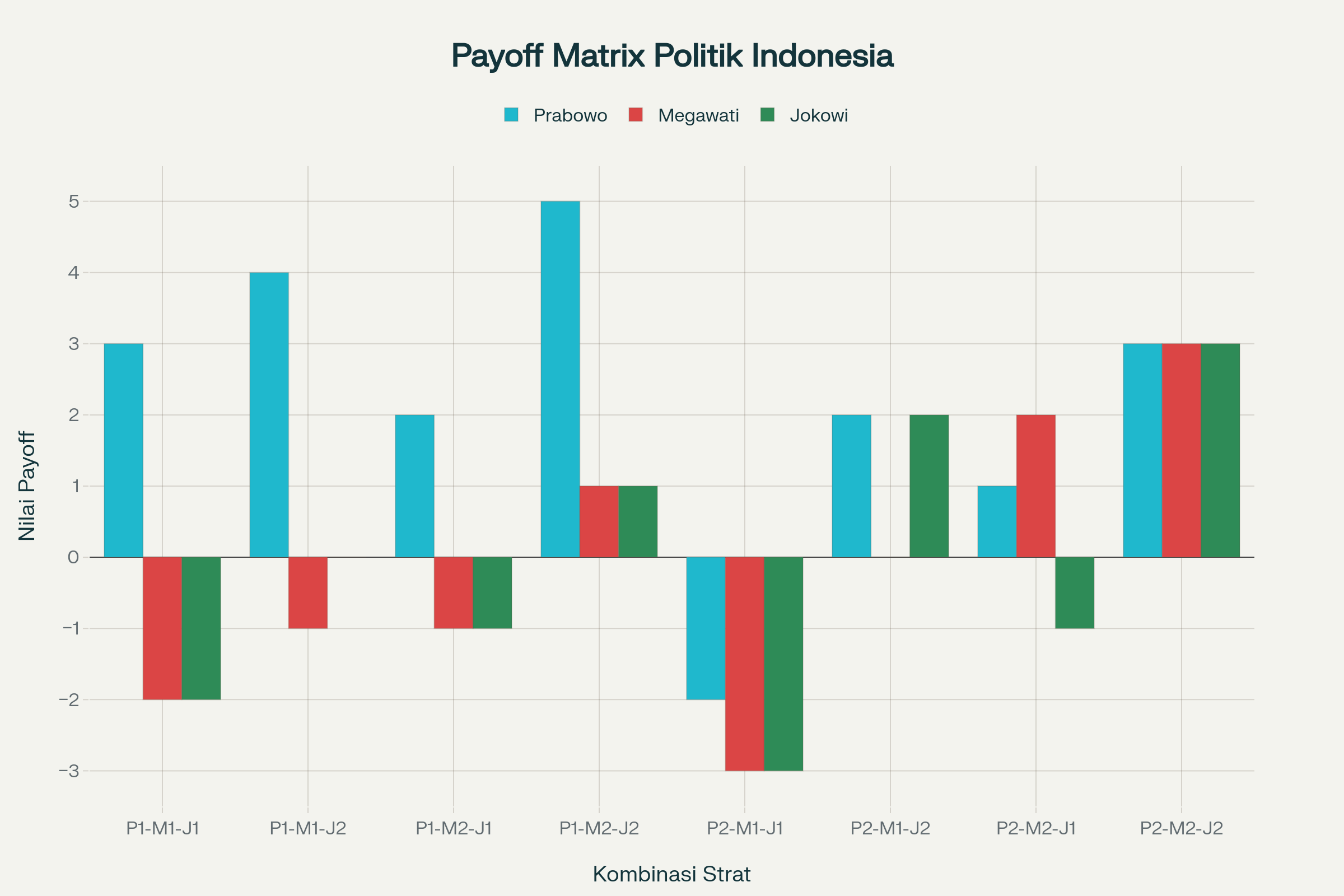
| Prabowo Strategy | Megawati | Jokowi | Outcome | Payoff (P,M,J) | Probability |
|---|---|---|---|---|---|
| P1: Consolidate | M1: Opposition | J1: Resistance | Military Takeover | (3,-2,-2) | 25% |
| P1: Consolidate | M1: Opposition | J2: Passive | DPR Dissolution | (4,-1,0) | 30% |
| P1: Consolidate | M2: Cooperate | J1: Resistance | Chaos/Instability | (2,-1,-1) | 15% |
| P1: Consolidate | M2: Cooperate | J2: Passive | Presidential Dominance | (5,1,1) | 20% |
| P2: Accommodate | M1: Opposition | J1: Resistance | NKRI Fragmentation | (-2,-3,-3) | 5% |
| P2: Accommodate | M1: Opposition | J2: Passive | Status Quo Tension | (2,0,2) | 10% |
| P2: Accommodate | M2: Cooperate | J1: Resistance | Parliamentary Crisis | (1,2,-1) | 8% |
| P2: Accommodate | M2: Cooperate | J2: Passive | Democratic Stability | (3,3,3) | 12% |
Nash Equilibrium Analysis
Primary Nash Equilibrium
Strategy Combination: (P1, M2, J2)
- Outcome: Presidential Dominance with Limited Opposition
- Payoff: (5, 1, 1)
- Probability: 20%
Rationale:
- Prabowo maximizes power through consolidation
- Megawati gets minimal benefits through cooperation
- Jokowi preserves existing positions through passivity
Secondary Nash Equilibrium
Strategy Combination: (P1, M1, J2)
- Outcome: DPR Dissolution & Presidential Power Expansion
- Payoff: (4, -1, 0)
- Probability: 30%
Rationale:
- Prabowo consolidates without accommodation costs
- Megawati loses parliamentary platform
- Jokowi maintains neutrality
Outcome Probability Matrix
| Outcome | Strategic Path | Probability | Key Triggers |
|---|---|---|---|
| DPR Dissolution | P1-M1-J2 | 30% | Parliamentary scandals + Military support |
| Presidential Dominance | P1-M2-J2 | 20% | PDI-P accommodation + Jokowi passivity |
| Military Takeover | P1-M1-J1 | 25% | Elite deadlock + Constitutional crisis |
| Democratic Stability | P2-M2-J2 | 12% | Elite coordination + Military restraint |
| Chaos/Instability | P1-M2-J1 | 15% | Mixed signals + Policy failures |
| Status Quo Tension | P2-M1-J2 | 10% | Balanced opposition + Limited reforms |
| Parliamentary Crisis | P2-M2-J1 | 8% | Legislative deadlock + Bureaucratic resistance |
| NKRI Fragmentation | P2-M1-J1 | 5% | Central authority collapse + Regional exploitation |
Hunting Game Dynamics
Coordination Problem Matrix
When camps must choose between Restraint (R) or Aggression (A)
| All Choose R | Mixed R/A | All Choose A | |
|---|---|---|---|
| Outcome | Democratic Stability | Military Arbitration | Authoritarian Takeover |
| Prabowo Payoff | 3 | 4 | 2 |
| Megawati Payoff | 3 | 0 | -2 |
| Jokowi Payoff | 3 | 1 | -2 |
| Military Payoff | 1 | 4 | 5 |
Key Insight: Individual rational strategies (Aggression) lead to collectively suboptimal outcome (Military dominance)
Military as Fourth Player
Military Strategy Options
- T1: Institutional Expansion (Gradual power increase through legal means)
- T2: Direct Intervention (Constitutional crisis exploitation)
Military Payoff by Political Outcome
| Political Configuration | T1 Payoff | T2 Payoff | Military Preference |
|---|---|---|---|
| Democratic Stability | 2 | -1 | T1 |
| DPR Dissolution | 4 | 3 | T1 |
| Presidential Dominance | 3 | 2 | T1 |
| Military Takeover | 3 | 5 | T2 |
| Chaos/Instability | 2 | 4 | T2 |
| NKRI Fragmentation | 1 | 3 | T2 |
Regional Separatism Conditional Matrix
Papua Independence Probability by Central Government Stability
| Central Stability Level | Independence Probability | Triggering Conditions |
|---|---|---|
| High Stability | 5% | Status quo maintenance |
| Moderate Instability | 15% | Jakarta political crisis |
| Severe Crisis | 40% | Military coup or civilian breakdown |
| State Collapse | 75% | Complete central authority failure |
Strategic Recommendations by Player
For Kubu Prabowo
Optimal Strategy: P1 (Consolidate) with selective M2 accommodation
- Risk: Military dependence creates long-term vulnerability
- Opportunity: Constitutional manipulation before opposition organizes
For Kubu Megawati
Optimal Strategy: M2 (Cooperate) with credible M1 threat
- Risk: Accommodation legitimizes authoritarian consolidation
- Opportunity: Extract maximum concessions through strategic cooperation
For Kubu Jokowi
Optimal Strategy: J2 (Passive) with bureaucratic network preservation
- Risk: Complete marginalization in new system
- Opportunity: Position for future political comeback
Critical Decision Points
Timeline of Strategic Inflection Points
- 2025 Q4: PDI-P Congress – Megawati’s cooperation decision
- 2026 Q2: Regional Elections – Democratic legitimacy test
- 2026 Q4: Constitutional Review – Military role formalization
- 2027: Mid-term Crisis Point – Economic/corruption pressures peak
- 2029: Next Presidential Election – System durability test
Game-Changing Events (Low Probability, High Impact)
| Event | Probability | Impact on Matrix |
|---|---|---|
| Prabowo Health Crisis | 15% | Reshuffles all strategic calculations |
| Major Corruption Conviction | 25% | Triggers impeachment scenario |
| Papua Independence Declaration | 8% | Activates military intervention |
| Economic Crisis (>20% inflation) | 30% | Increases chaos probabilities |
| Military Leadership Split | 12% | Reduces military effectiveness as kingmaker |
Conclusion: Matrix-Predicted Outcomes
Most Likely Path (50% combined probability):
- DPR Dissolution (30%) → Presidential Dominance (20%)
- Gradual authoritarian consolidation with formal democratic retention
- Military expansion through legal channels rather than direct coup
Democratic Survival Path (12% probability):
- Requires unprecedented elite coordination
- Military restraint despite institutional incentives
- External pressure for democratic accountability
System Breakdown Path (30% combined probability):
- Military Takeover (25%) or Chaos/Instability (15%)
- Triggered by elite deadlock and constitutional crisis
- Papua independence risk escalates significantly
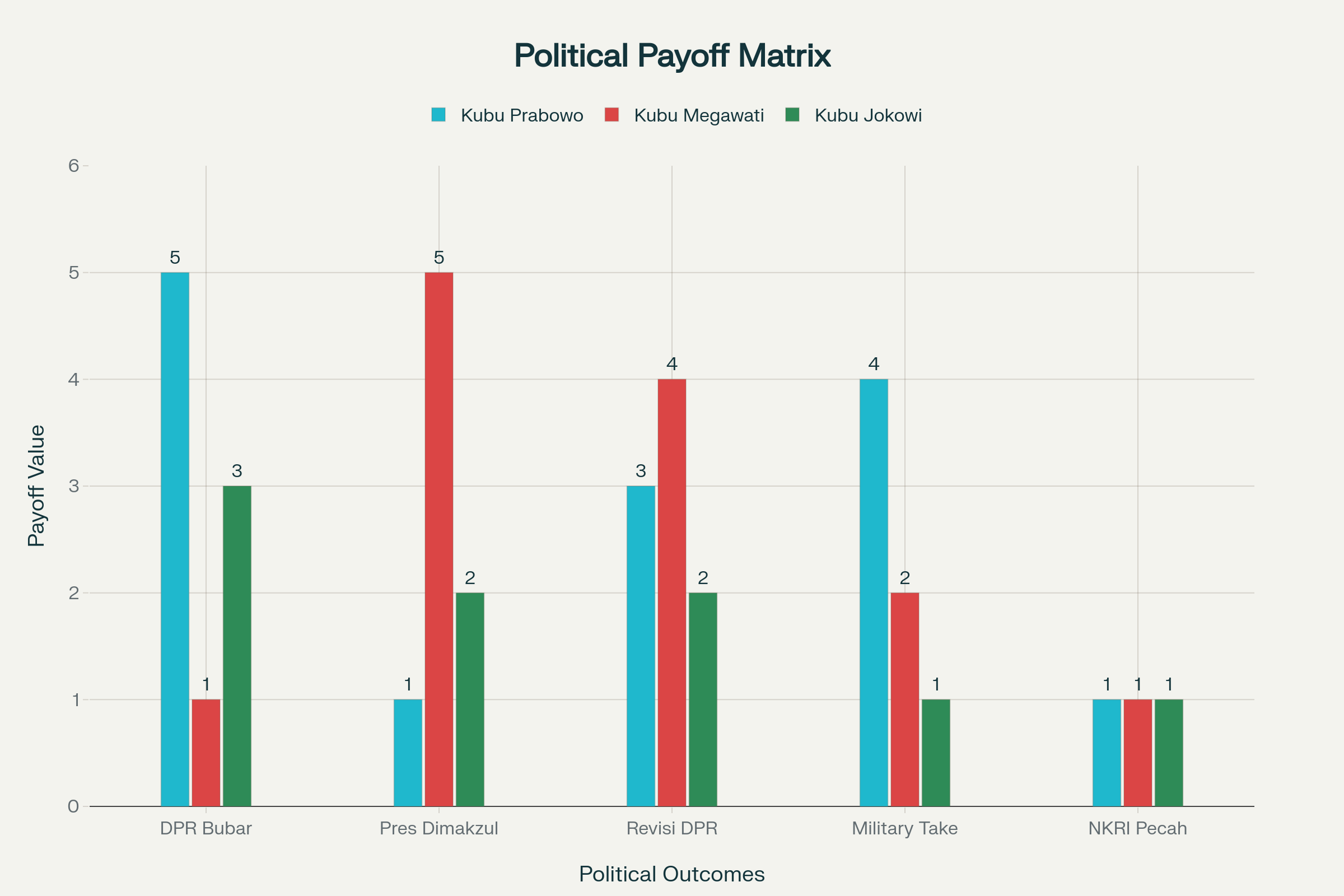
The matrix reveals that Indonesia’s current institutional design creates powerful incentives for authoritarian consolidation, making democratic outcomes dependent on extraordinary political restraint and cooperation that contradicts individual camp interests.
 Bhyllabus l'énigme
Tinggalkan komentar