
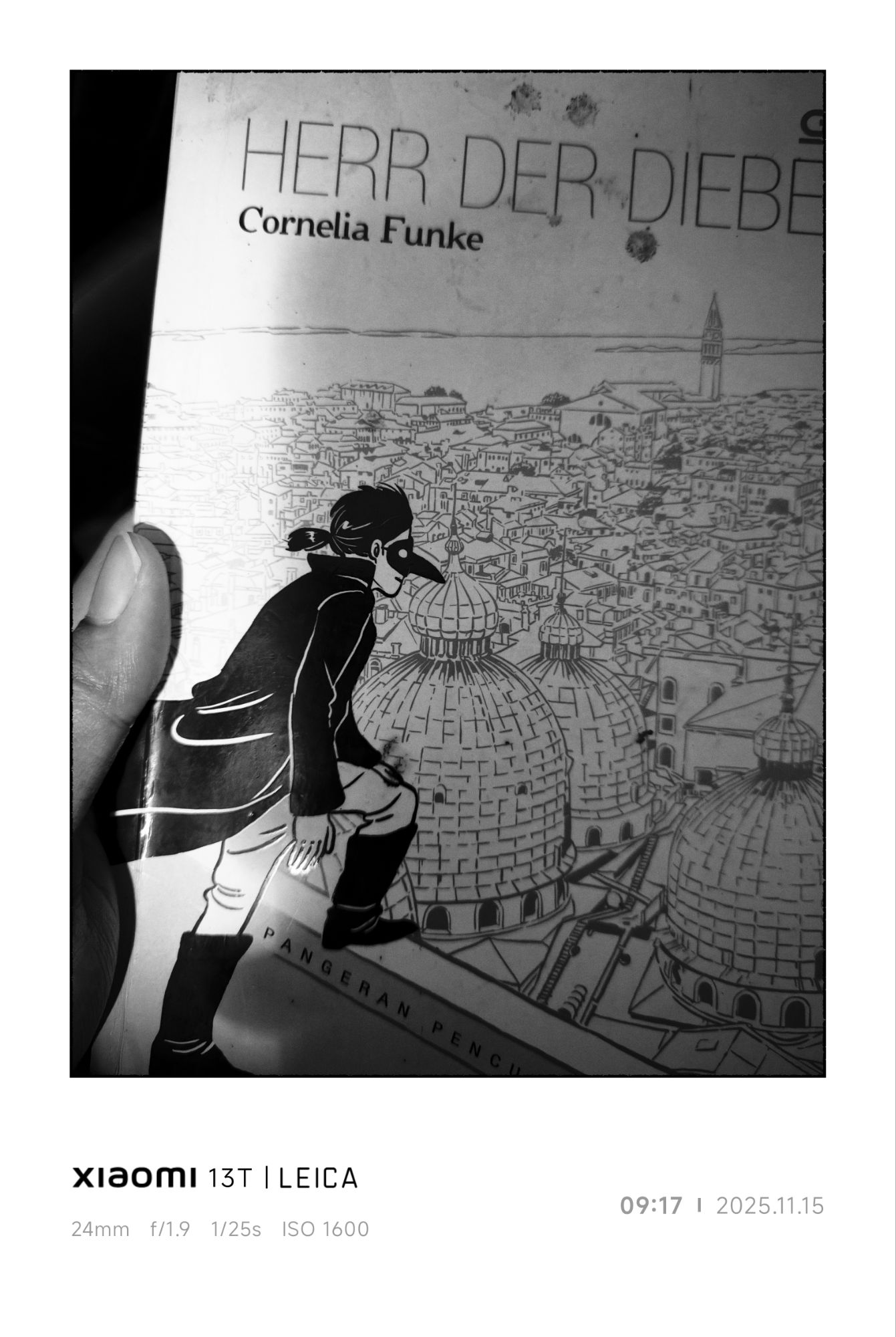
There’s a worn copy of Cornelia Funke’s Herr der Diebe (The Thief Lord) on my shelf, its pages marked somewhere in the middle where life interrupted. Years ago, I began this journey through Venice’s shadowed canals and forgotten corners, only to be pulled away by the relentless current of work and responsibility. Now, I’m going back.
A Story That Waited
The Thief Lord is patient in the way all good books are. It doesn’t demand; it simply exists, holding open a door to another world. Funke’s Venice isn’t just a backdrop—it’s a living, breathing character in itself. The city of masks and mysteries, where ancient stones remember centuries of secrets, where orphans and runaways can disappear into the labyrinth of alleyways and emerge transformed.
The premise is deceptively simple: two brothers, Prosper and Bo, flee to Venice to escape an aunt who wants to separate them. There, they find refuge with a gang of street children led by the enigmatic Scipio—the Thief Lord—who steals from the wealthy to support his makeshift family. But as with all of Funke’s work, simplicity is merely the surface beneath which deeper currents flow.
Why Now? Why Again?
In healthcare, we deal in protocols and certainties, in evidence-based decisions and measured outcomes. There’s comfort in that structure, necessity in that precision. But magic—real magic—lives in the spaces between certainties, in the questions we can’t quite answer with flowcharts and guidelines.
The Thief Lord asks uncomfortable questions: What does it mean to grow up? Can we escape our pasts, or do they follow us like shadows across water? What makes a family—blood, or choice, or something else entirely? These aren’t questions with neat clinical answers.
Funke writes with a rare understanding that childhood and adulthood aren’t destinations but contested territories. Her characters don’t simply want to grow up or stay young—they grapple with the terrible complexity of time itself, the way it gives and takes away in the same breath.
For the Dreamers Who Had to Become Practical
Perhaps this book resonates differently now than it would have years ago. Back then, I might have read it as adventure. Now, having spent years in the machinery of institutional healthcare, having seen how systems can both save and suffocate, I suspect I’ll read it as something else—a reminder of what gets lost when we surrender entirely to the practical.
The street children in Funke’s Venice survive by their wits and protect each other with fierce loyalty. They’ve built something beautiful in the ruins of an old cinema, a sanctuary carved from abandonment. There’s poetry in that, and perhaps a gentle rebuke to those of us who’ve forgotten how to build sanctuaries of our own.
An Invitation to Other Readers
If you’re someone who loves atmospheric fantasy, who believes cities can hold magic in their ancient bones, if you’ve ever felt caught between who you were and who you’re becoming—The Thief Lord deserves your time.
Cornelia Funke has a gift for creating worlds that feel both fantastical and achingly real. Her Venice is a place where merry-go-rounds might grant wishes and where the line between thief and hero blurs in the mist rising from the canals. It’s a world worth visiting, or in my case, worth returning to.
For those of us who put down books mid-story and meant to come back—for those whose shelves hold more half-read promises than we’d care to admit—perhaps this is the invitation we needed. The Thief Lord and his band of orphans have waited patiently in their abandoned cinema.
It’s time to go back and see how their story ends.
The Thief Lord (Herr der Diebe) by Cornelia Funke is available in multiple languages, including this Indonesian edition from Gramedia Pustaka Utama. Whether you’re reading it for the first time or returning after years away, Venice’s magic awaits.
 Bhyllabus l'énigme
Tinggalkan komentar