
If you ask whether humans spend more time thinking about the future or the past, you’re asking: What haunts us more—what we’ve lost, or what we haven’t yet gained?
And the answer is both devastating and illuminating:
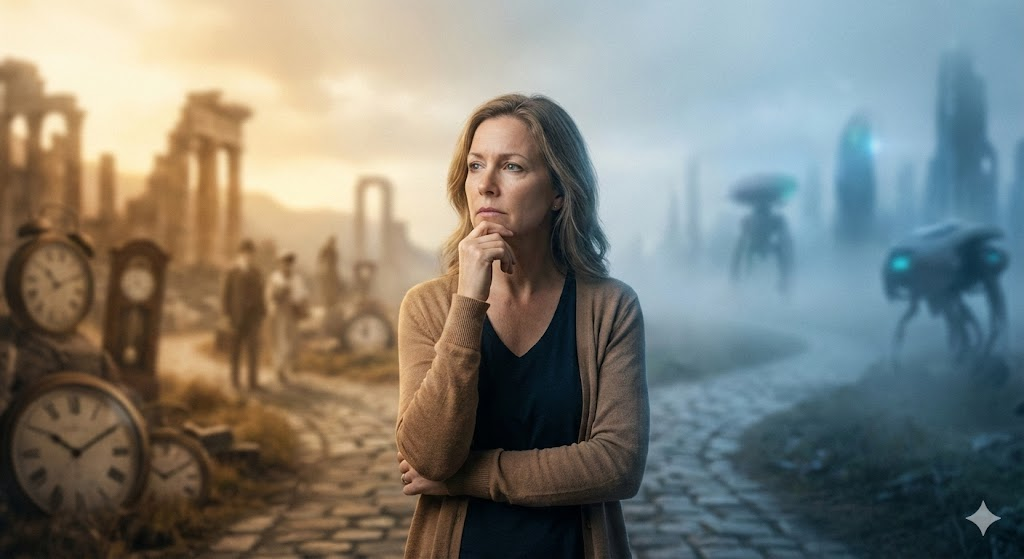
Most humans are almost never actually in the present. They’re oscillating between regret about the past and anxiety about the future, rarely landing fully in the only moment that actually exists—now.
But which direction pulls harder? That depends on what you’re running from.
The Pull Toward the Past
The past has gravity. It’s already happened. It’s solid, fixed, complete. You can replay it endlessly in your mind, examining it from every angle, trying to understand what went wrong or preserve what went right.
Why Humans Are Drawn Backward
Unfinished business.
The past contains unresolved conflicts, unanswered questions, conversations that ended wrong, relationships that broke without closure. Your mind returns to these like a tongue to a broken tooth—compulsively, painfully, unable to leave it alone.
If only I had said this… If only I had chosen differently… If only I had known then what I know now…
The past becomes an endless revision project. You rewrite the script, rehearse better responses, imagine alternative outcomes. As if thinking about it enough could change what happened.
The search for meaning.
Humans are meaning-making creatures. When something painful happens, we can’t just accept “it happened.” We need to know why it happened, what it means about us, whether we could have prevented it.
So we dig through the past like archaeologists, looking for the moment where things went wrong, the decision that led to the current pain, the pattern that explains the suffering.
Sometimes this is useful—you learn from mistakes, recognize patterns, grow.
But often it’s just suffering twice: once when it happened, and again (and again, and again) in memory.
Nostalgia as anesthesia.
When the present is unbearable, the past becomes sanctuary. You remember when things were better, simpler, more hopeful. When you were younger, less burdened, more alive.
The golden age that never quite existed but feels more real than the grinding present. Remember when… becomes a refuge from look at now.
This is particularly strong in people who feel:
- Their best years are behind them
- They’ve peaked and are now declining
- The world was better before and is getting worse
- They made a wrong turn somewhere and everything since has been consequence
For them, the past isn’t just memory—it’s the last place they felt alive, and they keep returning there because the present offers nothing better.
Trauma’s endless loop.
Traumatic memories don’t behave like regular memories. They intrude. They hijack the present and force you back into the moment of harm, again and again.
The mind returns to trauma trying to process it, to integrate it, to make sense of the senseless. But unprocessed trauma just keeps replaying, like a record stuck in a groove.
For trauma survivors, it’s not a choice to think about the past. The past won’t stop thinking about them.
The Cost of Past-Dwelling
People who live primarily in the past:
Miss the present entirely.
They’re at dinner with family but thinking about the argument from ten years ago. They’re in a beautiful moment but remembering when moments used to feel more beautiful. They’re with someone who loves them but comparing them to someone from the past.
The present becomes invisible because the past is so loud.
Can’t move forward.
If all your energy is spent replaying what happened, what’s left for creating what comes next? The past-dweller is stuck—not physically, but psychologically. They might move through life, but they’re dragging the past with them like chains.
Suffer from regret.
Regret is the specific suffering of past-orientation. I should have done this differently. Why didn’t I know better? How could I have been so stupid?
Self-blame becomes constant background noise. And since you can’t change the past, the regret is permanent—or at least feels that way.
The Pull Toward the Future
The future has magnetism. It’s unknown, uncertain, full of possibility—and threat. Your mind leaps toward it constantly, trying to predict, control, prepare.
Why Humans Are Drawn Forward
The need to control uncertainty.
The future is fundamentally uncertain. Anything could happen. For a species that survived by predicting threats and planning ahead, uncertainty feels dangerous.
So the mind races forward:
- What if this happens?
- What if that goes wrong?
- What will I do if…?
- How can I prevent…?
Planning becomes compulsive worry. You’re not just preparing—you’re catastrophizing, running every possible disaster scenario, trying to anticipate and control what cannot be controlled.
Hope as motivation.
When the present is difficult, the future becomes the place where things finally get better.
When I get the promotion… When I lose the weight… When I finally achieve X… Then I’ll be happy. Then life begins.
The future becomes where you’ve stored your happiness, postponed indefinitely. The present is just the waiting room for the life you’ll eventually live.
This keeps people moving—working toward goals, striving, improving. But it also means they’re never satisfied with now, because now is always just the not-yet-future.
Fear of loss.
If you have something good, the future threatens to take it away:
- This relationship will end
- This health will decline
- This job will disappear
- This happiness can’t last
Anxiety lives in the future. It’s the anticipation of pain that hasn’t happened yet but might. The mind races ahead to protect you from imagined threats, creating suffering over possibilities rather than realities.
Ambition and becoming.
Humans are uniquely capable of imagining who they could become and working toward that future self. This is beautiful—it’s how we grow, achieve, transform.
But it also creates suffering: If your worth is tied to becoming that future self, then your current self is always inadequate. You’re always not-yet-enough, measuring yourself against a standard you haven’t reached.
The treadmill of arrival: You think “when I achieve this, I’ll be content.” But when you arrive, the goalposts have moved. The future you were chasing becomes the present you’re dissatisfied with, and you project happiness onto a new future.
The Cost of Future-Dwelling
People who live primarily in the future:
Never arrive.
They’re always preparing, planning, working toward. They sacrifice the present for a future that, when it arrives, they don’t actually enjoy because they’re already focused on the next future.
Life becomes a series of deferred experiences. I’ll rest when… I’ll be happy when… I’ll live when… But “when” never comes because the future, by definition, never becomes now—it just becomes a different future.
Suffer from anxiety.
Anxiety is the specific suffering of future-orientation. What if things go wrong? What if I fail? What if I lose what I have?
Worry becomes constant background noise. And since you can’t control the future, the anxiety is permanent—or at least feels that way.
Miss the present entirely.
They’re with their child but thinking about college tuition in 15 years. They’re on vacation but worrying about the work waiting when they return. They’re in a good moment but already anticipating when it will end.
The present becomes invisible because the future is so loud.
The Pattern: Neither Past Nor Future Is Now
Here’s what becomes clear:
Whether you’re oriented toward past or future, you’re not present.
Past-dwelling is: I am what I’ve been. My mistakes define me. The best is behind me. I’m trapped by history.
Future-dwelling is: I am what I’ll become. My worth is in achieving. The best is ahead of me. I’m trapped by anticipation.
Both are forms of escape from the present moment.
Why? Because the present moment often contains discomfort:
- Boredom
- Uncertainty
- Imperfection
- Ordinariness
- Things as they are rather than as we wish they were
So we flee into mental time travel—backward to memory or forward to imagination—because being here, now, exactly as things are, is difficult to tolerate.
Which Direction Is Natural?
So: Do humans naturally spend more time thinking about the future or the past?
The answer depends on temperament, life stage, and circumstance.
Temperamental Differences
Anxious people tend toward future: What will go wrong? How can I prevent it? What if, what if, what if?
Depressed people tend toward past: What went wrong? Why am I like this? How did I get here?
Optimists lean future: Things will get better. I’m working toward something. The best is coming.
Pessimists can go either way: The past was better (nostalgia) or the future will be worse (doom).
Life Stage Differences
Youth (teens, twenties) leans future:
- Endless possibility ahead
- Haven’t accumulated much past to regret
- Identity still forming—focused on becoming
- Building toward: career, relationships, life structure
Middle age (thirties, forties, fifties) oscillates:
- Enough past to have regrets
- Enough future to have anxiety
- The pressure of both: undoing past mistakes while securing future stability
- Often the most temporally fragmented—pulled in both directions
Old age (sixties and beyond) leans past:
- More past than future
- Less to look forward to (mortality approaching)
- More to look back on—a lifetime of memory
- The work becomes integration: making peace with what was
Though some elders remain radically future-focused (legacy, what they’re leaving behind) and some young people are haunted by past trauma.
Circumstantial Differences
In crisis, people lean future: How do I survive this? What do I do next? How do I escape?
After crisis, people lean past: How did this happen? What did I miss? What should I have done?
In success, people lean future: What’s next? How do I maintain this? What more can I achieve?
In failure, people lean past: Where did I go wrong? What mistake led here? How do I undo this?
In grief, people live in past: The person is gone. All that remains is memory. The future without them is unbearable, so you stay in the past where they still exist.
The Evolutionary Answer
From an evolutionary perspective, both orientations were survival mechanisms:
Past-orientation: Learning from experience. That berry made me sick—don’t eat it again. That predator attacked from that direction—watch for it. That strategy worked—remember it.
Memory is how we avoid repeating fatal mistakes.
Future-orientation: Anticipating threats and opportunities. Winter is coming—store food now. That predator might return—prepare defenses. That opportunity might appear—be ready.
Planning is how we survive what hasn’t happened yet.
Both were adaptive. The humans who couldn’t learn from the past or plan for the future died. The ones who could—survived, reproduced, became our ancestors.
But modern life weaponizes these capacities:
The past that was supposed to teach us lessons becomes an infinite loop of regret and rumination.
The future that was supposed to help us prepare becomes an infinite source of anxiety about threats that may never materialize.
We’re using stone-age brains in a modern world, and the mismatch creates suffering.
The Real Answer: We’re Escaping the Present
The question isn’t really “past or future?”
It’s: Why are we so allergic to now?
Because now is where:
- Things are imperfect and we can’t immediately fix them
- We feel the full weight of our limitations
- Boredom exists (if nothing dramatic is happening)
- Mortality exists (we’re alive, but not forever)
- Responsibility exists (we have to choose, and choices have consequences)
- Reality exists (as it is, not as we wish it were)
The past is safe because it’s already happened. You can’t change it, which means you’re not responsible for it anymore. You can just analyze it, regret it, romanticize it—but you don’t have to act.
The future is controllable (in fantasy) because it hasn’t happened yet. You can imagine perfect outcomes, plan meticulously, believe that with enough preparation you can prevent disaster. You’re active, but you don’t have to actually do anything yet—just think about doing.
But the present demands you actually show up.
To be present means:
- Accepting what is, even if you don’t like it
- Feeling what you’re feeling, even if it’s uncomfortable
- Being responsible for your choices right now
- Facing mortality (you’re alive now, but this moment will pass and eventually so will you)
- Tolerating the ordinary (most moments aren’t dramatic or meaningful)
This is hard. So we escape into time that isn’t now.
The Cost of Never Being Present
People who live primarily in past or future:
Never develop presence.
The capacity to simply be with what is—without judging it, fixing it, escaping it—atrophies. They become tourists in their own lives, observing from a distance but never fully arriving.
Create suffering that isn’t necessary.
The past happened. You can’t change it. Replaying it doesn’t change it. But you suffer as if it’s happening now.
The future hasn’t happened. Most of what you worry about never happens. But you suffer as if it’s happening now.
You’re suffering over time that doesn’t exist while missing the only time that does.
Can’t connect deeply.
Real connection happens in presence. You can’t truly see someone if you’re thinking about past grievances or future possibilities. You can’t truly be seen if you’re not actually here.
Relationships require now. And people who live in then (past) or when (future) struggle to build intimacy, which only exists in now.
Live half-lives.
They’re going through motions. Checking boxes. Present physically but absent psychologically. Years pass, and they realize: I wasn’t actually there for any of it.
They were thinking about the past or planning for the future while life happened around them, unnoticed.
The Path Back to Now
The answer isn’t to stop thinking about past or future. Memory and planning are essential human capacities.
The answer is to develop the ability to return to the present when you choose to.
Not because the present is always pleasant.
But because it’s the only place where you’re actually alive.
The past exists only in memory—a reconstruction in your mind. The future exists only in imagination—a projection from your mind. The present is the only thing that’s real.
And learning to inhabit it—even when it’s difficult, even when it’s ordinary, even when it’s painful—is the foundational skill for being human.
Not always. Not perfectly. But more often. More consciously.
The Answer to Your Question
Do humans spend more time thinking about future or past?
It depends on who they are and what they’re running from.
But the real answer is:
Humans spend most of their time thinking about anything except the present moment.
Because the present moment demands we actually be here. Actually feel what we’re feeling. Actually see what’s in front of us. Actually take responsibility for who we are and what we’re doing.
And that’s harder than escaping into the past or the future.
So we split our attention:
- Regretting what was
- Anxious about what might be
- Rarely fully inhabiting what is
This is the human condition: Consciousness cursed with the ability to leave the present moment while the body remains trapped in it.
We are time travelers stuck in now, constantly trying to be anywhere else.
And the great spiritual task—whether you call it mindfulness, presence, awakening, or just paying attention—is learning to finally, fully, arrive in the only moment you ever actually have.
Where does your mind spend most of its time? In memory or anticipation? And what are you avoiding by not being here?
 Bhyllabus l'énigme
Tinggalkan komentar