
There was once a traveler who asked a sage beneath a banyan tree: “What makes a family more than strangers sharing a roof?” The sage replied: “The rituals they weave together—threads invisible yet stronger than iron.”
The Tradition of the Shared Table
Confucius taught that li—ritual propriety—begins not in temples but at the family table. When a family gathers to eat together, they practice what the Sufi poets called sohbet: communion of souls through presence. The meal need not be elaborate. A simple bowl of rice, shared in attention, becomes sacred.
The tradition might be as quiet as this: every evening, before the first bite, each person names one good thing from their day. Or perhaps Sunday morning congee, prepared together, where the youngest stirs and the eldest tastes.
The Tradition of Story and Remembrance
The Mahabharata was not written to be read alone—it was spoken aloud across generations, grandmother to grandchild, each telling adding new breath to ancient bones. Every family carries its own epic: the tale of how your grandparents met, the journey that brought your ancestors to this land, the small miracle of your own birth.
Marcus Aurelius wrote that we should begin each day remembering those who came before us. A family might keep this tradition: lighting a small candle on the anniversary of a departed loved one, speaking their name aloud, telling one story the children have not yet heard. In this way, the dead continue to teach.
The Tradition of Seasonal Awareness
The Taoists understood that human life flows within the greater life of earth and sky. A family rooted in place learns to mark the seasons—not merely by calendar, but by attention. When the mango tree flowers, we make this dish. When the rains come, we gather for this game. When harvest moon rises, we watch it together from the same spot each year.
These rhythms become the heartbeat of belonging.
The Tradition of Silence Together
Not all communion requires words. The Zen master Thich Nhat Hanh spoke of “lazy days”—time when a family simply is together without agenda. Perhaps one morning each week, the family sits in the garden, each doing their own quiet thing: reading, sketching, watching clouds. The Buddhist concept of sangha—spiritual community—finds its most intimate expression here: the warmth of presence without demand.
The Tradition of Questions
The Jewish Passover Seder begins with a child’s question: “Why is this night different from all other nights?” This is profound pedagogy: wisdom not declared but drawn out through wonder. A family might cultivate this by asking, each week, a question no one yet knows the answer to. Why do we dream? What happens when we forgive? What would you teach your younger self?
The Greek philosopher Socrates believed the unexamined life was not worth living. A family that questions together learns together.
The Tradition of Service
In Ubuntu philosophy: Umuntu ngumuntu ngabantu—”A person is a person through other people.” The family that serves together beyond its own walls discovers that love is not a private treasure but a river that must flow to remain pure. Perhaps monthly, the family prepares food for those in need, or tends a corner of the neighborhood. Confucian ren—benevolence—begins at home but cannot end there.
The Tradition of Creation
To make something together—a garden, a song, a simple wooden box—is to weave your lives into matter. The Hindu concept of yajna (sacred offering) suggests that all creation is an act of devotion. A family might keep one project always alive: a journal passed from member to member, a quilt added to each year, a tree planted for each child and tended by all.
The Tradition of Gratitude’s Edge
The Stoic Epictetus taught his students to hold all things lightly, for nothing is truly ours. A family tradition of gratitude might include this edge of awareness: We are grateful for this table, these faces, this evening—not because they will last forever, but precisely because they will not. Perhaps at year’s end, the family gathers to speak aloud what they are grateful for—and what they are willing to release.
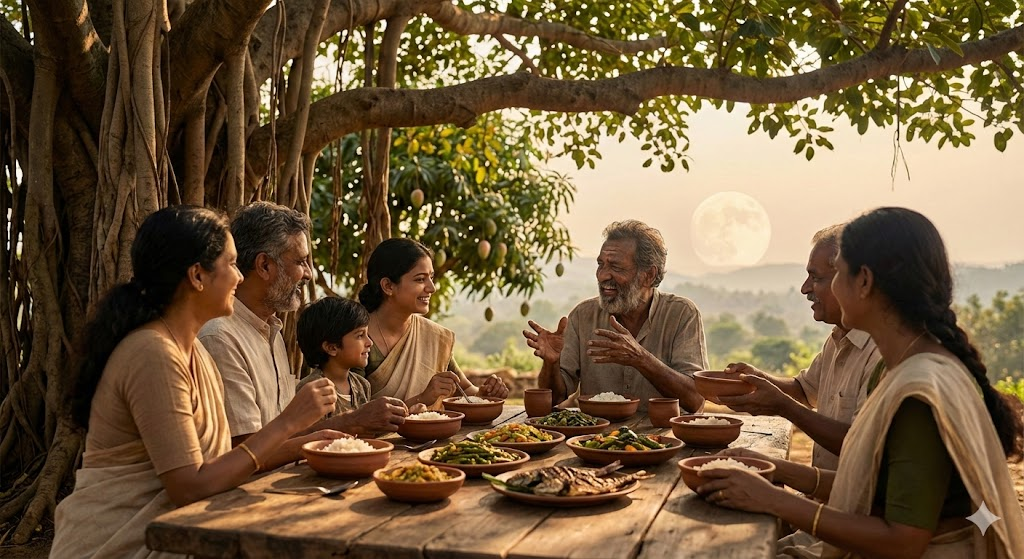
A tradition, the old sage concluded, is not a chain that binds. It is a song that remembers itself each time it is sung. The melody may shift across generations—a note added here, a verse forgotten there—but the singing itself is the inheritance.
What traditions will your family sing into being?
 Bhyllabus l'énigme
Tinggalkan komentar