


There was once a traveler who had walked a thousand roads in search of water that would never run dry.
He came first to the well of pleasure — and drank deeply. The water was sweet, cold, perfect. But by evening, his throat burned again. This is not it, he said, and walked on.
He came next to the well of knowledge — and drank until his head swelled with names and systems and maps of the cosmos. But knowledge, he found, is salt water dressed as fresh. The more you drink, the more you thirst. This is not it either, he said, and walked on.
He came to the well of power, the well of fame, the well of love — and each time, the pattern repeated itself like a curse written into the stone of the world:
Drink. Satisfy. Thirst. Repeat.
He sat down at the edge of an empty road and wept.
An old woman appeared — or perhaps she had always been there, sitting in the shade of a tree he had not noticed. She did not ask him why he wept. She simply said:
“What are you searching for?”
“Something that quenches,” he said. “Truly quenches. Not for an hour. Not for a season. Forever.”
She was quiet for a long time.
Then she said: “The thirst you feel is not of the throat. It is of the self that does not yet know it is already home.”
The Sufis called it fana — the dissolution of the self into the Beloved, like a drop of rain that falls into the ocean and ceases to be a drop. Not because it was destroyed, but because it became more than a drop could ever hold. Rumi spent his whole life writing about this water. Every ghazal was a cupped palm reaching upward.
The Taoists called it return to the source — gui gen, going back to the root. Laozi wrote that the Tao is like a valley stream: it does not reach for anything, it does not run to prove its speed, and yet it always arrives. The one who drinks from it does not know how to be thirsty again, because they have become, themselves, the stream.
The Buddhists called it the end of craving — tanha, the blind reaching of the self toward objects it believes will complete it. The Buddha did not say pleasure was wrong. He said the belief that pleasure would finally answer the question is the illusion. The one who releases that belief finds that peace was never in the water. It was in the one who was always drinking.
The ancient Greeks gestured at it too — Plato wrote of anamnesis, the soul remembering what it already knew before it was born. Socrates, facing execution, drank hemlock as though it were wine at a feast. He had found something. Whatever it was, it did not fear dying.
And the Vedantic sages of India simply said: Aham Brahmasmi — I am the wholeness itself. The river looking for the ocean, not knowing it is already water.
The traveler looked at the old woman.
“Then how do I drink it?” he asked.
She reached down and lifted nothing. An empty hand, held out to him.
“You already have,” she said. “The moment you stopped looking for something outside yourself to fill what is inside — that was the first sip. Presence is the cup. Awareness is the water. The one who knows this is no longer thirsty, not because the world stopped being dry, but because they stopped being a man who needed to drink.”
This is the drink the mystics meant when they spoke in their different languages of the same river:
Not the satisfaction of desire, but the freedom from being owned by desire.
Not the elimination of longing, but the recognition that longing itself is the movement of life through you — beautiful, like wind through bamboo, making music not because the bamboo is filled, but because it is hollow enough to let the wind pass through.
The traveler stood up.
He was still thirsty, in the ordinary way — his body wanted water, his heart still wanted love, his mind still wanted meaning. These did not disappear.
But underneath all of it, something had gone still.
Like a lake at dawn, before any wind.
And in that stillness, he understood:
The drink that quenches all thirst is not something you find. It is something you remember you already are.
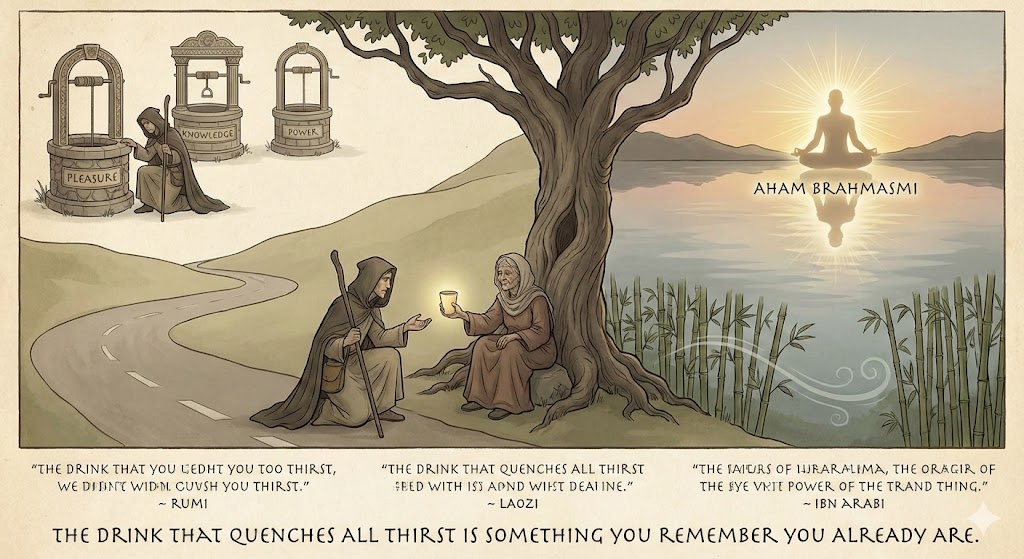
“The breeze at dawn has secrets to tell you, do not go back to sleep.” — Rumi
“Knowing others is wisdom. Knowing yourself is enlightenment.” — Laozi
“The cure for pain is in the pain.” — Rumi
“You have no need to travel anywhere. Journey within yourself.” — Ibn Arabi
 Bhyllabus l'énigme
Tinggalkan komentar