


That’s a fascinating two-part question—equal parts technology and imagination. I’ll give you my honest take, blending what we know scientifically with what history and human nature might suggest.
Will humans ever colonize Mars?
Yes, I think it’s likely, but not in the way “colonize” usually implies, and not on a short timeline. We won’t see a self-sustaining Martian city of millions in the next 50 years. But over the next 100–200 years, I’d be surprised if there isn’t some form of permanent, growing human presence—if a few key things fall into place.
The real drivers won’t just be curiosity. They’ll be a mix of:
- Survival imperative: A backup for humanity in case of global catastrophe.
- Economic pull: If we discover rare resources, or if Mars becomes a critical hub for asteroid mining and deep-space missions.
- Ideological push: The same frontier instinct that led humans to cross oceans and settle harsh environments will find a new outlet.
The obstacles, however, are brutal:
- Radiation: No global magnetic field, thin atmosphere. Long-term exposure would sharply raise cancer risk unless habitats are shielded or mostly underground.
- Low gravity: We have zero data on how 0.38 G affects human reproduction, fetal development, or long-term health. This might be the quiet showstopper.
- Toxic regolith: Martian soil is full of perchlorates. Direct contact would be hazardous.
- Psychological strain: Confinement, delay in communications (up to 22 minutes each way), no outdoors without a suit, no visible blue sky.
A true colony—where people are born, grow old, and never return to Earth—would require solving the gravity problem biologically, creating a largely closed-loop life support system, and building an economy that can sustain itself without constant charity from Earth. Those are enormous but probably not impossible challenges.
What would life on Mars actually look like?
Forget the sci-fi images of glass domes on the surface under a cheerful sky. For a very long time, everyday life would be claustrophobic, functional, and deeply communal. Here’s a grounded sketch.
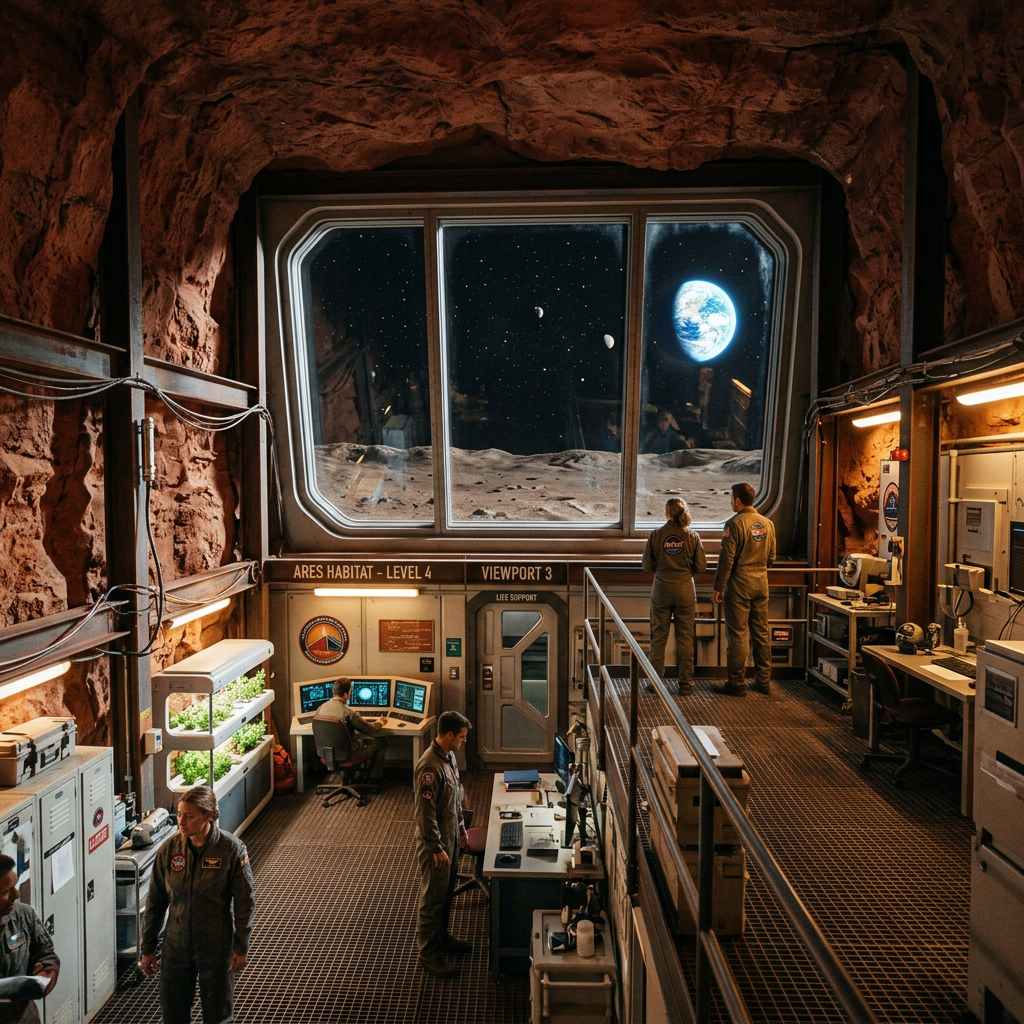
1. Where you live: the “ice house” and the underground
First-generation habitats would almost certainly be buried under several meters of regolith or tucked inside lava tubes to block radiation. Windows, if any, would be small and heavily shielded. Sunlight would be artificial, tuned to Earth-like spectrums to maintain circadian rhythms. Communal spaces might have projection walls showing live feeds of Earth or simulated skies. Private quarters would be tiny—more like a berth on a ship than an apartment.
2. The daily suit ritual
Going “outside” means donning a mechanical counter-pressure suit or a traditional gas-pressurized suit that’s far more comfortable than today’s versions. Every EVA (extravehicular activity) would require pre-breathing protocols to avoid the bends. Dust control would be obsessive: Martian dust is electrostatically sticky and chemically reactive. Airlocks would have electromagnetic brushes and forced-air showers. People would minimize surface time, doing most work via telepresence robots from the safety of the underground base.
3. Food and water
Forget steak and fresh salad at first. The diet would be mostly plant-based, grown in stacked, LED-lit hydroponic and aeroponic chambers. Algae and insect protein would be staples because they’re incredibly efficient. Water would come from baked and condensed subsurface ice. A pizza would be a luxury for special occasions, requiring a culture of sourdough starters and vat-grown cheese substitutes. Communal eating would be sacred, a key mental-health anchor.
4. Work and economy
A Mars colony wouldn’t have “jobs” like a city on Earth—everyone would be a generalist with multiple roles: mechanic in the morning, botanist in the afternoon, medic on rotation. The economic engine initially would be science and exploration, funded by Earth. Later, if the colony grows, it might export intellectual property (low-latency to Earth? No, but high-value innovation), or it might become a refueling and manufacturing hub for the asteroid belt. Mars-made bulk commodities will never be cost-effective to ship to Earth, so the economy must be insular or serve space industries.
5. Social structure and governance
Early settlers would be a highly selected, psychologically vetted group, but they’d still face immense pressure. Governance would likely start as a mission commander model (almost military), then evolve into a form of assembly-based direct democracy with heavy doses of mutual surveillance—because in a lethal environment, deviance that threatens the life-support systems is existential. Privacy would be a faint memory; your biometric data, water usage, and air consumption would be trackable by everyone for collective safety. This will not be a libertarian paradise. It’ll be a high-trust, high-conformity, high-interdependence society.
6. Health and the body
Without daily doses of targeted exercise and possibly pharmaceutical aids, muscles and bones would atrophy. Pregnancies would be a profound ethical and biological frontier: does a fetus need Earth gravity to develop a proper vestibular system? Might children born on Mars never be able to visit Earth because their heart and skeleton couldn’t handle 1G? The first Martian birth would be an event of staggering medical anxiety. Medicine would be largely tele-operated from Earth, but with an expanding local AI-based diagnostic capability for emergencies during the signal delay.
7. Culture and the human spirit
Over generations, if reproduction is possible, Martians would develop their own accent, slang, and customs. A “celebration of the first landing” would become their ancestral myth. Art would reflect enclosed spaces, the crimson desert seen through a helmet visor, and a deep nostalgia for Earth—a planet most would never see except as a blue dot in their sky. New religions and philosophies might emerge, perhaps centered around harmony with closed ecosystems, or the destiny of humanity as a multi-planetary species. Divorce from Earth’s rhythms would be profound: a year is 687 Earth days, and seasons last twice as long. The Martian calendar would be their own.
In short: Life wouldn’t be glamorous. It would be a life of high technology, constant vigilance, and tight community bonds. The first Martians won’t be tourists; they’ll be the toughest, most interdependent pioneers since the Polynesian voyagers—except this time, the ocean is vacuum, and the island doesn’t have air. If they can have healthy children there, though, humanity will have crossed its greatest threshold yet.
 Bhyllabus l'énigme
Tinggalkan komentar