
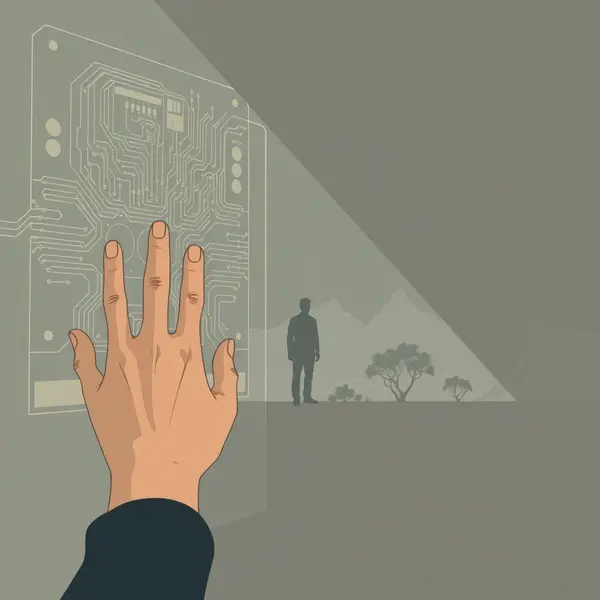
Automation used to be discussed mainly as a labor problem: machines would take tasks, jobs would change, and societies would need to decide how to share the gains. The newer philosophical pressure is different. When machines begin to think, recommend, classify, and decide, the question is no longer only who works, but who is still treated as a responsible author of the world. The current debate around automation, human control, and the meaning of work suggests that the deepest risk is not simply idleness. It is a subtler erosion: human judgment becoming decorative while automated systems carry the real weight of choice.
1. Control as ritual: when the human in the loop becomes a rubber stamp
Many powerful AI developers insist that humans must remain in control. That claim sounds reassuring, but it becomes philosophically thin if the human role is reduced to approving outputs already shaped by opaque systems. Control is not merely the presence of a person near a screen. It requires the ability to understand, question, override, and bear responsibility for the outcome. When those capacities are absent, human oversight can become a ritual of legitimacy rather than a genuine exercise of agency.
From oversight to responsibility
A meaningful human-in-the-loop arrangement must answer three questions. First, can the person actually contest the machine recommendation? Second, does the person have enough time, information, and authority to act differently? Third, is responsibility assigned to humans in a way that matches their real power? If the answers are no, the system may be automated in substance even when it appears human-centered in form.
- Formality without power: approval becomes theater when the operator cannot realistically refuse the machine.
- Responsibility without knowledge: blame cannot be justly placed on people who cannot inspect the reasoning behind an action.
- Speed without deliberation: automation can compress decision time so severely that reflection becomes impossible.
2. Freedom without friction: why effortless automation can diminish agency
One of the most provocative recent arguments is that total automation may dissolve the very freedom it promises. If every obstacle is removed, choice may lose its texture. Philosophical work on effort and uncertainty makes a related point: meaningful activity often depends on some resistance, some risk of failure, and some need to adapt. A world in which outcomes are instantly optimized can feel liberating, but it can also make human agency harder to recognize.
The historical lesson of transformed labor
Technology has always reshaped work. The image of laborers slowly chipping at slate with metal poles reminds us that technological change is not new. What is new is the possibility that machines may not only change the tools of labor but also absorb the deliberative functions once reserved for human beings. The question is not whether automation is efficient. It is whether efficiency is allowed to erase the conditions under which people learn, struggle, and become authors of their lives.
- Effort as formation: struggle can shape skill, patience, and moral attention.
- Uncertainty as meaning: not knowing the outcome in advance can make an action genuinely one’s own.
- Constraint as freedom: limits can clarify purpose rather than merely obstruct it.
3. Beyond intelligence: what remains human when machines become articulate
As machines become more capable, the temptation is to define humanity by comparison: if machines can reason, write, and generate images, then perhaps human worth must lie somewhere else. But this is a fragile strategy. It makes dignity dependent on outperforming a tool. A richer philosophical position is to value what makes us human beyond intelligence and productivity: vulnerability, embodiment, mortality, care, loyalty, and the capacity to be held accountable within a community.
The danger of anthropomorphizing machines while automating persons
There is a strange symmetry in contemporary culture. Machines are described in increasingly human terms, while human beings are increasingly managed as if they were predictable inputs. This double movement deserves scrutiny. If we grant machines the language of intention while reducing workers to metrics, we risk inverting the moral order. The proper response is not to deny machine capability, but to insist that personhood is not a performance metric. It is a status that grounds rights, responsibility, and recognition.
- Embodiment: human life is lived through bodies that tire, heal, and depend on others.
- Moral exposure: humans can be praised or blamed because they can understand reasons and answer for them.
- Relational identity: we become ourselves through promises, care, and shared institutions.
4. From transactions to transformation: the human work of meaning
Some workplace commentary urges organizations to let technology handle transactions so people can focus on transformation. That is a useful slogan, but it needs philosophical depth. Transformation is not merely a nicer category of task. It involves helping people change, learn, reconcile, create, and take responsibility. If automation is used only to strip friction from commerce, the human role may shrink to managing exceptions. If it is used to expand human attention, it can support mentorship, judgment, and care.
Work as more than output
Classical hopes for liberation from toil, from Čapek to Keynes, imagined that machines might free people from pressing economic necessity. Yet those hopes always carried a further question: what would people do with freedom? The answer cannot be only consumption or leisure. It must include the cultivation of capacities that make freedom meaningful. In an automated era, the central task is not merely to replace drudgery, but to protect the human ability to choose, contribute, and be recognized.
A practical closing: keeping automation answerable to human life
The philosophical issue becomes practical when institutions decide how to deploy automated systems. The goal is not to slow technology for its own sake, but to ensure that human control remains real. The following practices can help.
- Design for contestability: give people a clear, timely, and safe way to challenge automated decisions.
- Protect meaningful friction: preserve steps that require reflection, especially where learning and judgment matter.
- Separate approval from authority: do not treat a human signature as sufficient if the person lacks real power to change the outcome.
- Measure human development, not only throughput: evaluate systems by whether they increase skill, trust, and responsibility.
- Assign accountability where power lies: responsibility should follow actual control, not be displaced onto the nearest human.
- Cultivate non-optimizable goods: invest in care, citizenship, craft, and moral attention, which are not merely inefficient versions of machine tasks.
The future of automation will not be decided only by better models. It will be decided by whether societies can preserve a form of human life in which people remain more than users, validators, or residual exceptions. The human in the loop is not enough. What is needed is a human standing in the world: the power to question, the freedom to refuse, and the dignity to be more than the sum of one’s outputs.


Tinggalkan Balasan