
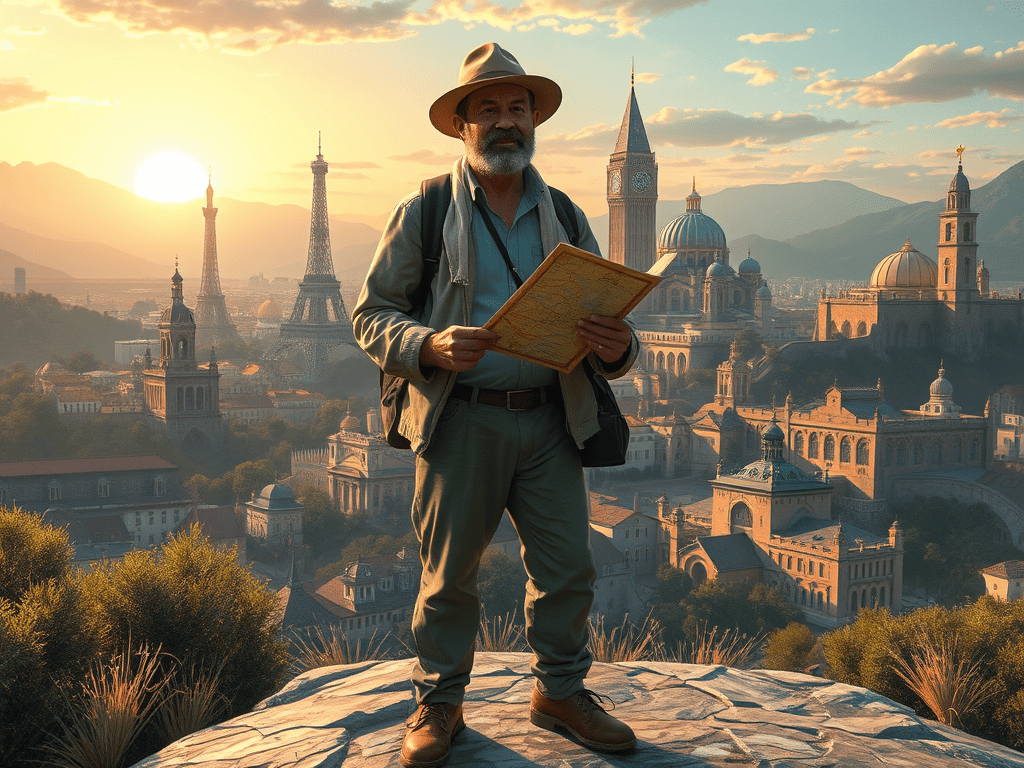
The Cartography of Belonging
A meditation on distance and devotion
There are those who measure their lives in leagues traveled, in borders crossed, in the accumulation of stamps upon weathered pages. They speak of villages left behind like discarded shells, of towns that blur into memory’s haze, of countries that become mere notations in the grand ledger of experience. Some have traversed continents, their footsteps marking out great arcs across the world’s curvature, while others—the dreamers, the stargazers, the perpetually restless—have cast their eyes beyond the sky’s dome itself, imagining planets as destinations, as new homes waiting to be claimed.
Yet here lies the great paradox of human wandering: for all our magnificent capacity for movement, for all the distances our bodies can span and our minds can conceive, there exists within each of us a compass that points not forward but backward, not outward but inward. It is a magnetic pull that recognizes no maps, acknowledges no borders, and remains unmoved by the grandest of journeys.
Watch the seasoned traveler in their hundredth foreign city. See how their eyes soften at the scent of bread that recalls their grandmother’s kitchen, how their shoulders settle at the sound of rain that echoes the rhythm of home’s roof. Listen as they speak of distant places with casual familiarity—”When I lived in Prague,” “During my years in Mumbai,” “That summer in Patagonia”—yet notice how their voice changes when they mention the place they began. It carries a different weight, a different gravity.
The heart, it seems, is a stubborn traveler. It plants its flag once, in soil that may be rich or poor, in ground that may be blessed or cursed, and there it remains. You can carry it across oceans, drag it through mountain passes, launch it toward distant stars, but it continues to beat with the rhythm of that first place, continues to pump blood that remembers its original longitude and latitude.
This is not failure. This is not lack of courage or imagination. This is the most human thing of all—to be capable of infinite expansion while remaining anchored to something infinitely small. A street corner where you learned to ride a bicycle. A kitchen table where you first understood that adults could be wrong. A view from a bedroom window that taught you the difference between weather and climate, between storm and season.
The true geography of a life cannot be measured in miles. It exists in the space between departure and return, in the eternal tension between motion and rest. We become citizens of the world not because we abandon our first country, but because we carry it with us, comparing every sunset to the one that first taught us beauty, every meal to the one that first taught us satisfaction, every goodbye to the one that first taught us sorrow.
So let the philosophers debate whether home is a place or a feeling. Let the poets argue whether belonging can be chosen or must be inherited. The wanderer knows a deeper truth: that distance is an illusion, that the farthest journey always leads back to the beginning, and that no matter how many light-years stretch between you and your origin, your heart remains exactly where you left it—in the soil of your becoming, in the very first place that whispered your name and meant it.
The great irony of exploration is this: the further we go, the more precisely we understand the coordinates of home. Every mile traveled is a measurement of love, every border crossed a reaffirmation of where we truly belong. We become cartographers of our own devotion, mapping not the world, but the exact dimensions of our own longing.
In the end, perhaps this is what it means to be human: to possess infinite capacity for movement and an infinite desire to return. To be both arrow and bow, both question and answer, both journey and destination. We travel not to escape ourselves, but to discover exactly who we were before we left, and exactly where we belong when the wandering is done.


Tinggalkan Balasan